Cruising life is testing the limits of my vanity (and teaching me new ones).
When we lived at the marina, water was easy – we could refill our empty tanks with no issue. Agora is a racer-cruiser sailboat that leans toward racer, so we don’t have many of the amenities traditional cruiser boats do, like solar panels, dinghy davits, or a watermaker.
We’re extra conscious of water usage – it means minimal soaping, saltwater rinses when possible, and short showers. Shaving is a luxury, and when it happens, it’s logistical. Still, I’ve joked for years with Barrett that I’m a lady of luxury.
Here’s the truth about life at sea: we do have hot days, salty skin, and limited water. But we don’t go to bed dirty or forsake hygiene for happiness. We live in a constant state of camp clean.
It’s kind of like glamping. It’s not “we have company coming” house clean, but it’s not fully off-the-grid middle-of-nowhere living either. (Though it is closer to the latter.) We’d love to install a watermaker onboard someday, but it’s a pricey project we’re not prioritizing yet. Sometimes Barrett and I have to choose between a full French press of coffee or two bags of tea. And that’s OK.
In the meantime, we get the dishes mostly done every day – and completely done in a big batch the next morning. There’s salt on every surface, but the sun dries things quickly.
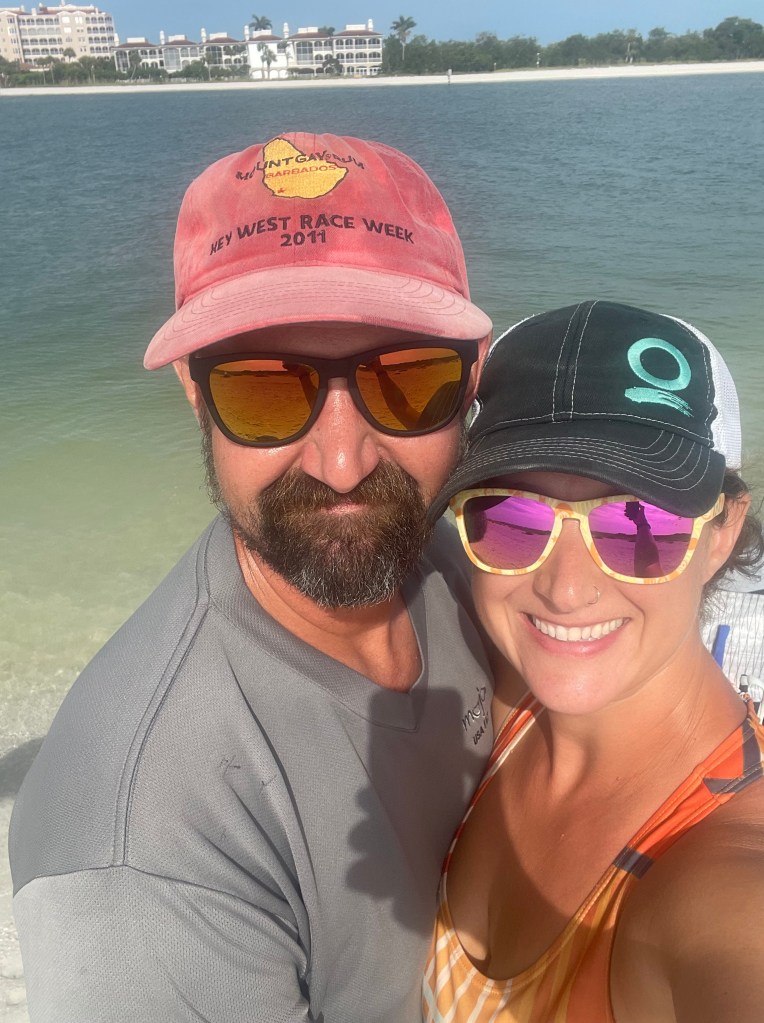
This chapter is teaching us to be more connected to our bodies and the earth. To feel less vanity and more freedom. I hope it’s doing the same for the kids – though they don’t have the same societal norms burned into their brains yet.
Messy today looks different than it did eight months ago, but there’s not much in our boat life that looks the same. Most things look better.
One thing Barrett and I reflect on often is how grateful we are for our time living at the marina before heading out to cruise full-time. That’s how we got to know the boat, its systems, Agora’s quirks, and our rhythms. Our priorities haven’t changed much – they’ve just come into better focus.
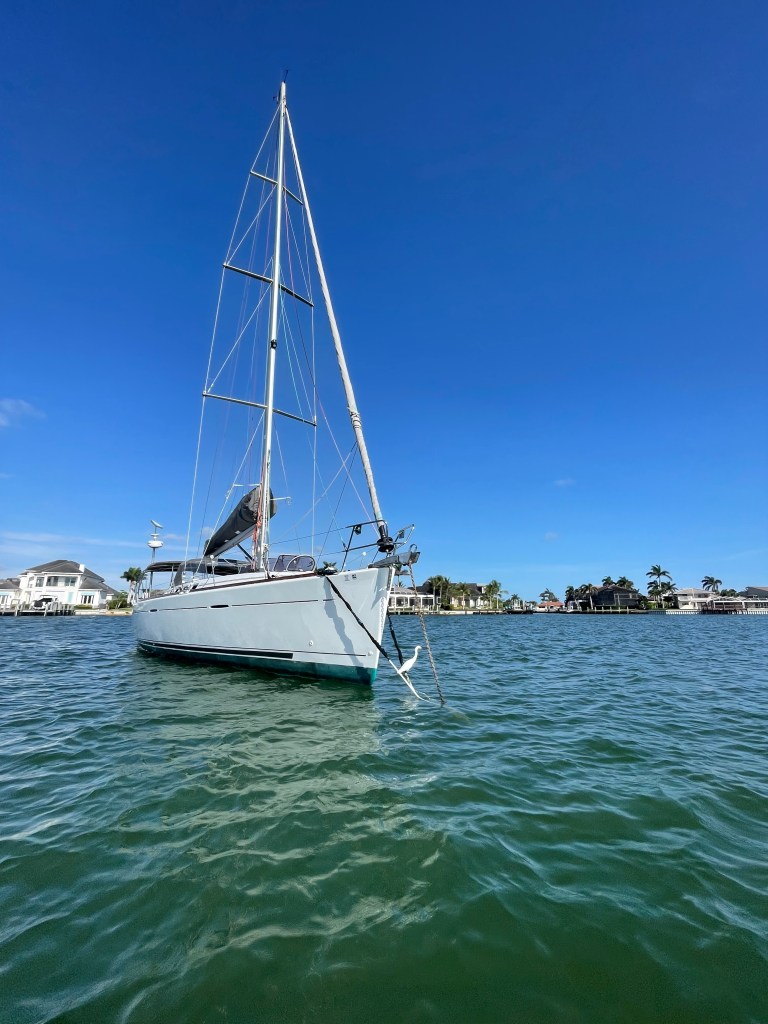
We arrived in Marco Island on Memorial Day, expecting to stay a few days and find a weather window to make the passage to Key West. When Friday came, we were both pretty worn out from the past week and ready to rest and explore – so we stayed put. Little did we know at the time, we were opting out of a potentially great weather window and ended up having to stick around Marco Island for another six days.
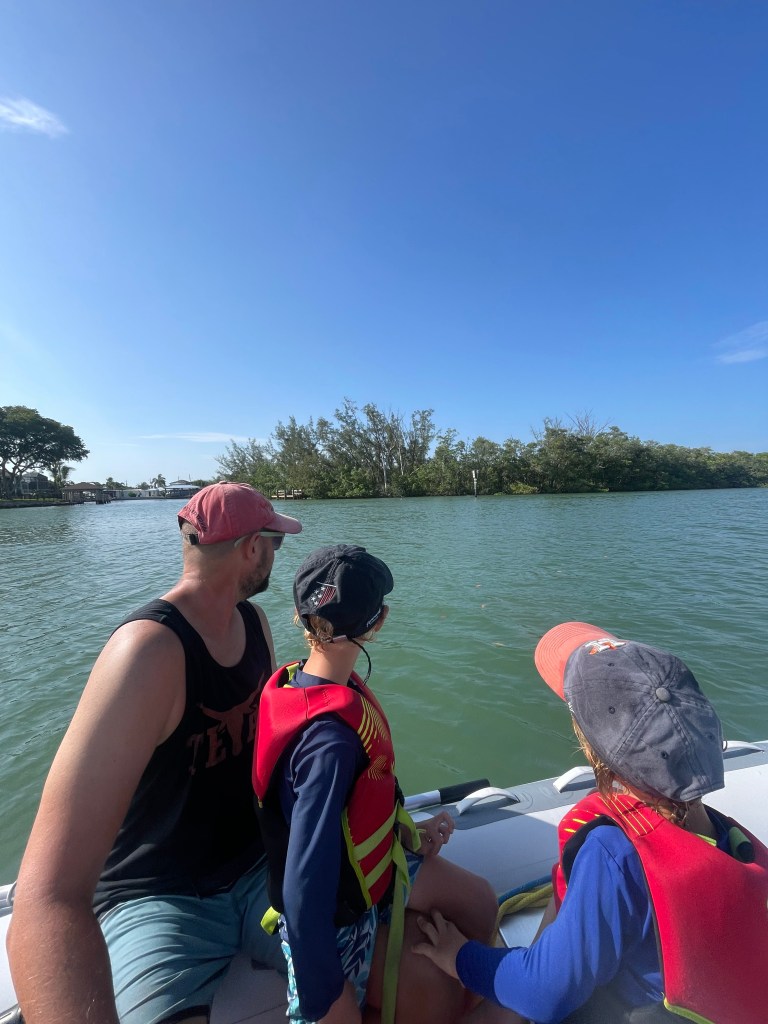
In retrospect, we would have left sooner than we did but our time there was good for a few reasons. It forced us to slow down, literally and figuratively – laws mandate idle speed in the bays and waterways of Marco Island. We observed wildlife and lived in the moment. It helped us settle into this cruising life and cherish the wonder on the kids’ faces, enjoying life on the hook and learning how to adapt when the weather has its plans.
Here are some Marco Island highlights:
A significant current in the wide channel coming in from the Gulf
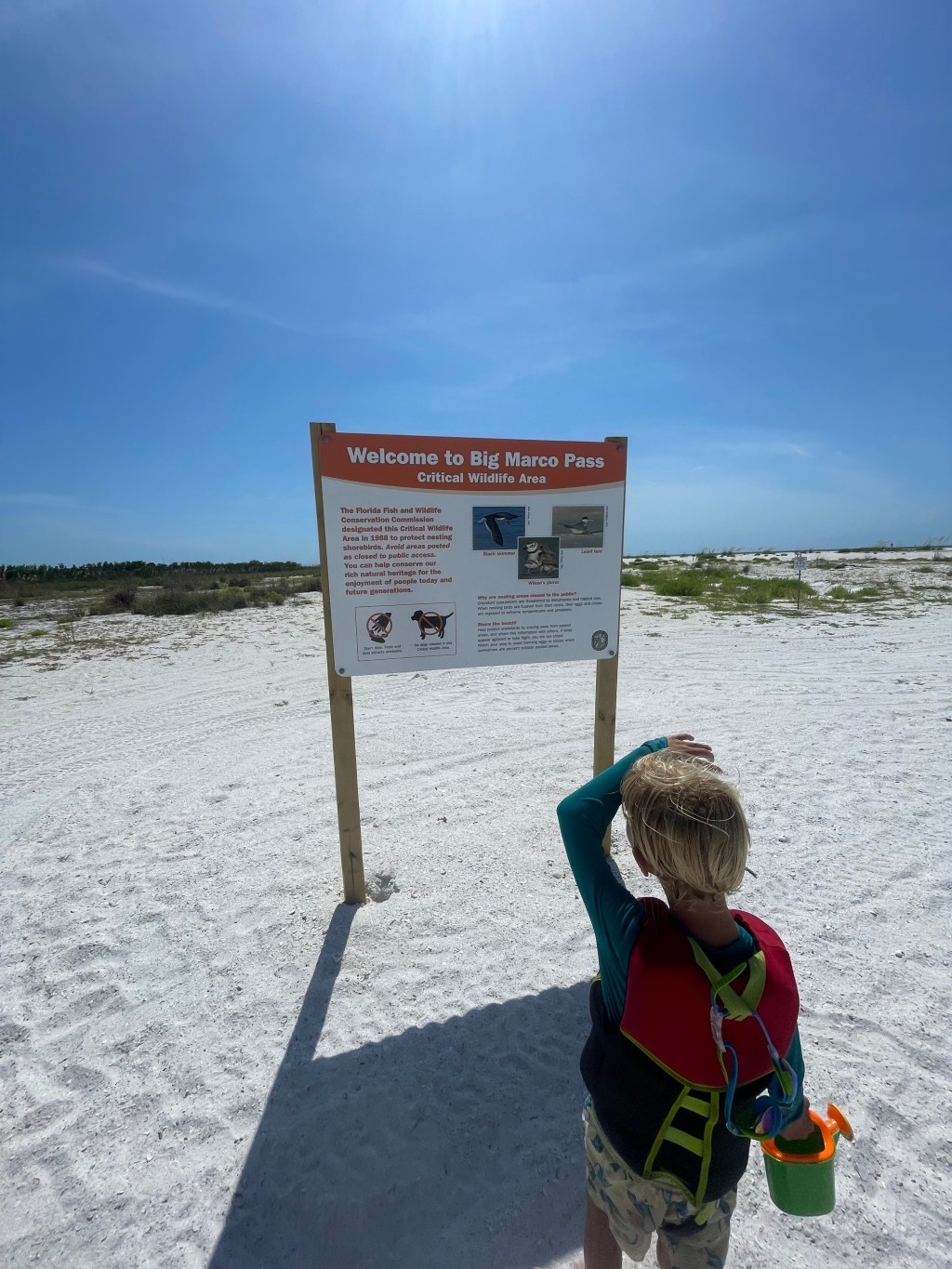
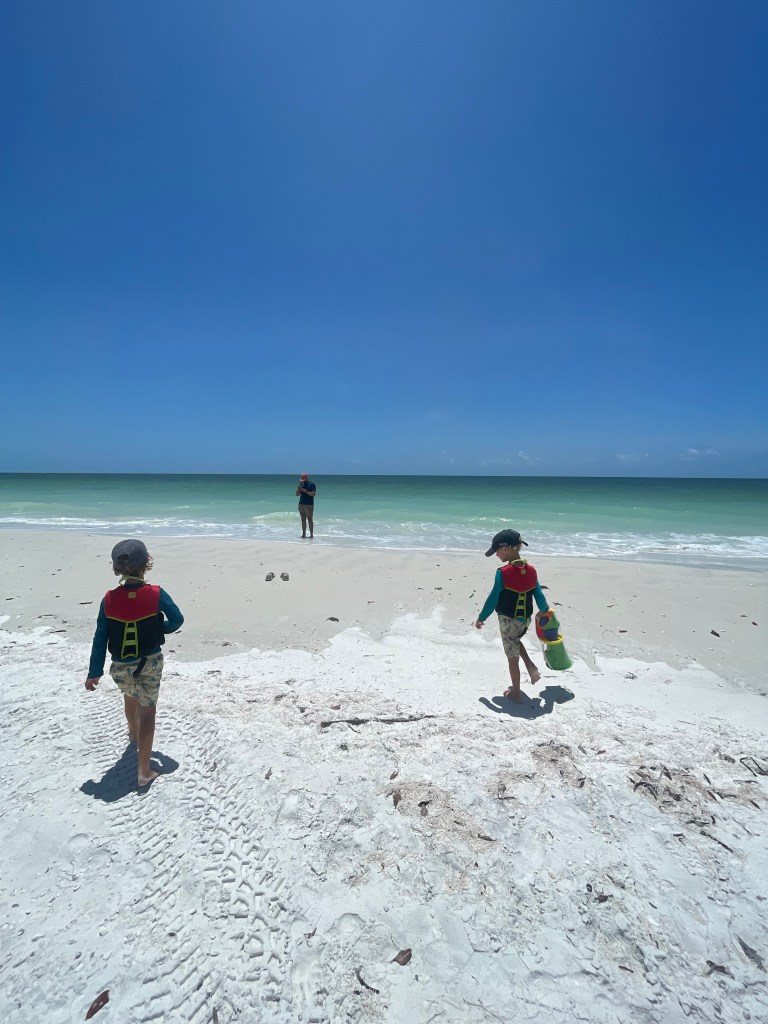
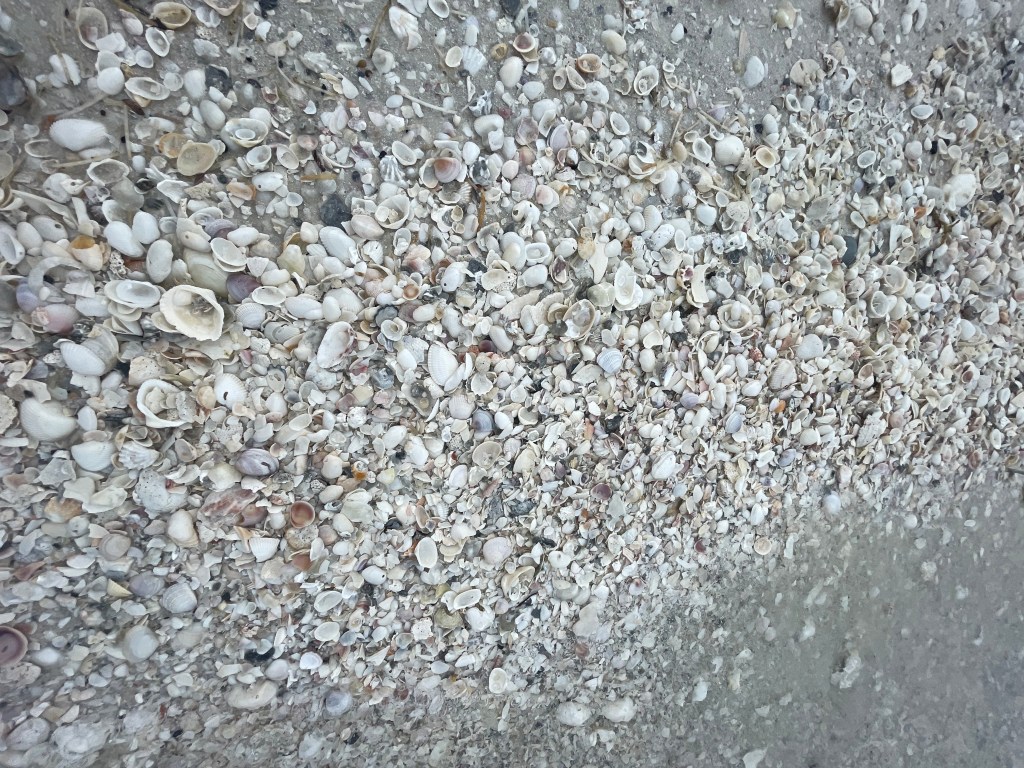
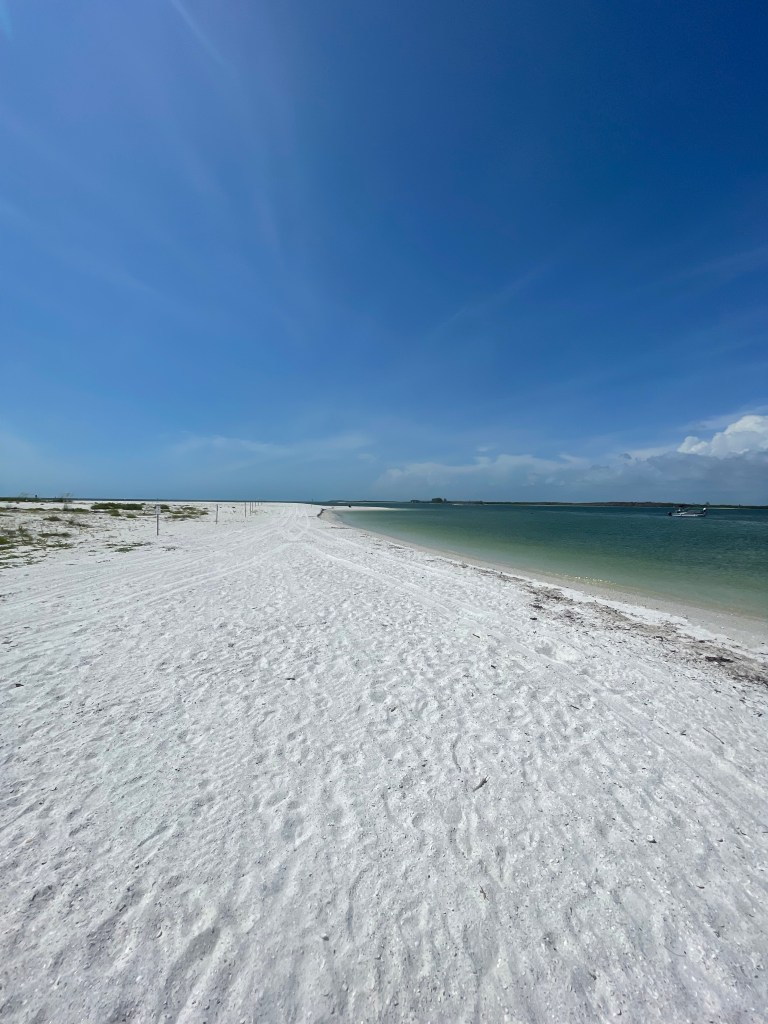
Beautiful beaches, full of shells worth staring at
The joy of fresh water – washing the boat and our clothes!
A too-shallow slip assignment in which Agora was sitting on the keel for hours when the tide went out (the marina apologized and refunded the stay)
Trouble finding Dolphin Tiki Bar & Grill, only to realize that their tagline is half the fun is finding us
Circling to find an anchorage after option one was too shallow and shifty from the river current
Manatees and natural beauty & a small-town feeling
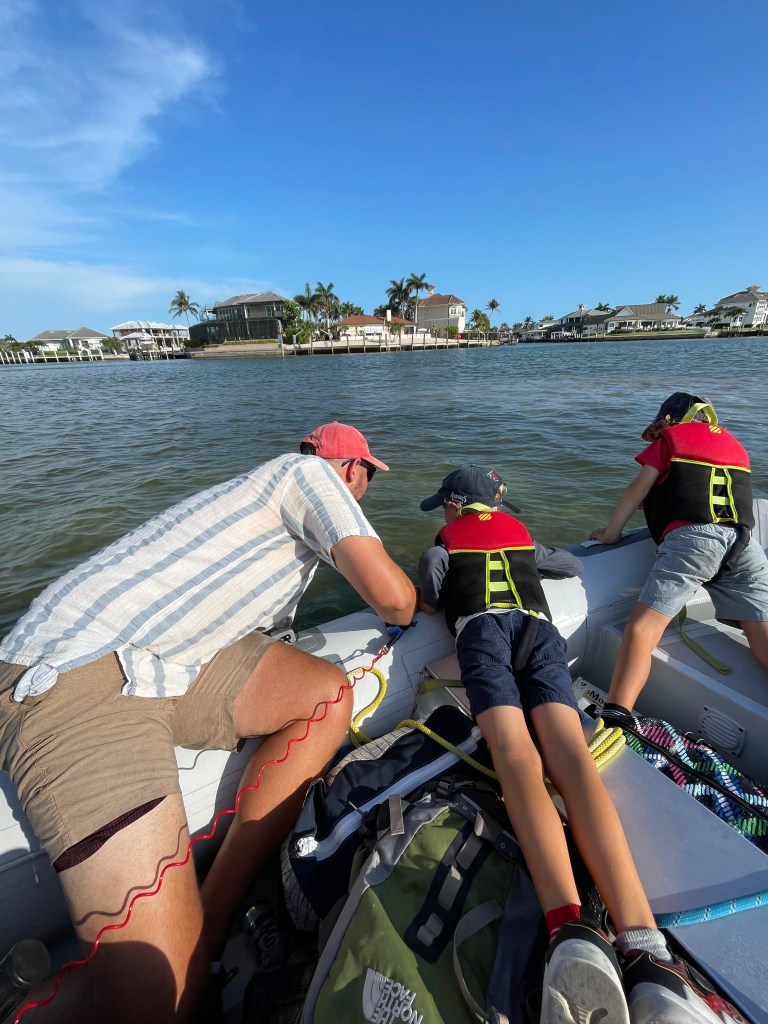
Dolphin close enough to touch from the dinghy (we didn’t)
Canals for days
Gold Star rating: the public dinghy dock for boat parking while shopping at Winn-Dixie
I’m proud of what we’ve done and smiling as the conversation begins:
Me: “North Claiborne Bridge, this is Sailing Vessel Agora with 70-foot air draft, we are in line at the Industrial Lock and looking to pass through in the next few minutes.”
Bridge operator: “Sailing Vessel Agora, please stand by… Hey Agora, is there any way you can lower your air draft?”
Like, cut down the mast?, I wonder.
Me: “No, sir, we have a 70-foot mast.”
Bridge operator: “Well, the bridge is out of order, should be running again mid next week.”
Pause… My brain stops, I don’t understand, I’m waiting for some indication this is a joke.
Me: “Can you tell me the nearest option to get through? We are trying to get to Gulfport and on to Pensacola.”
Bridge operator: <no answer>
Random barge operator (again, really super friendly guys): “Hey Agora, really, your only option is to head downriver to Baptise Collette and head up that way.”
Me: “OK, thank you.”
I look it up, and it’s 80 nm south in the wrong direction just to get to the gap. And then we have to go back up the same distance to Gulfport. We were almost done.
I go up on deck to tell the crew the news, and everyone looks at each other, shrugs, and then we turn down the river.
I could not ask for a better group. I’m sure people were frustrated and disappointed, but there was nothing to do but keep going. We spent the rest of the day heading down the mighty Mississippi, which, after the narrow ICW, seemed like a super highway. It’s 100 ft across, 100 ft deep, and because of the intense wind, the traffic is way down, with a lot of barges anchored to the side. Despite the frustrating circumstances, it’s kind of fun.
When we planned on doing the outside passage weeks before, our marina mate Tom (yes, same Tom from the beginning of the story) suggested we stop in Venice Marina via an inlet from the Gulf to rest and get gas. At the time, I said no way, because we were going all the way around offshore. Well, guess what is just next to Baptise Collette?
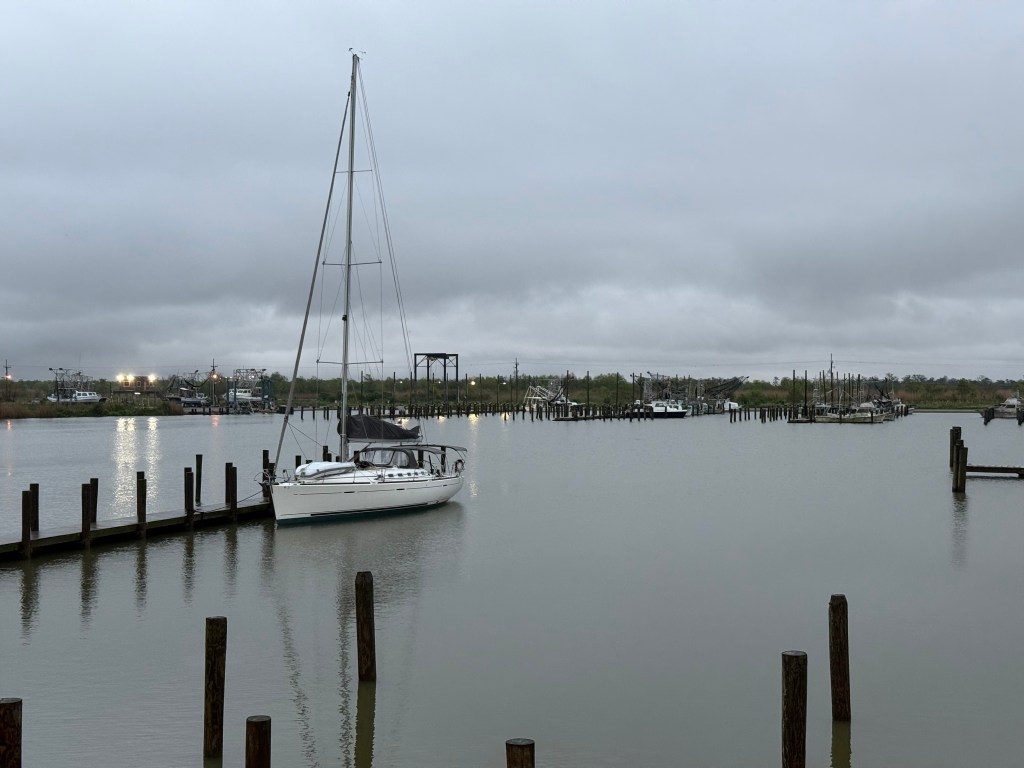
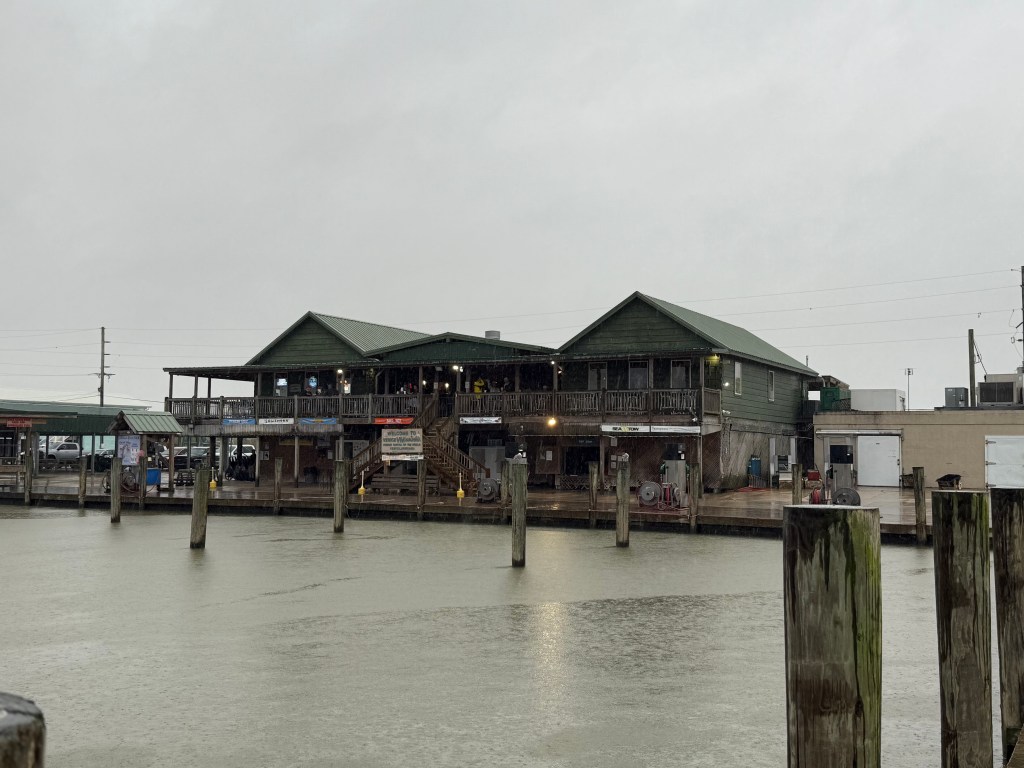
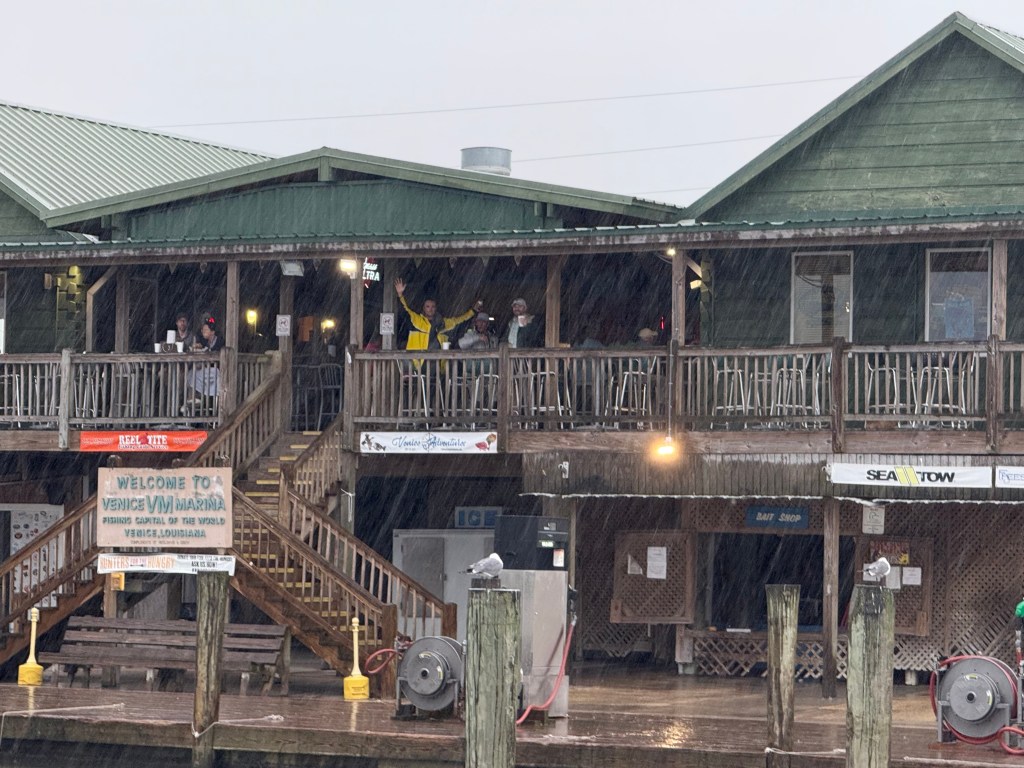
I’d like to say we pulled into Venice with no problem, but we managed to run aground on the way in and have our mystery throttle smoke and sludge problem, but in the end, we made it. We thought we’d be in Gulfport, and instead, we are pulling in to get fuel and stay for the night way farther south in a small town (population 500). To rest and re-plan the rest of our trip.
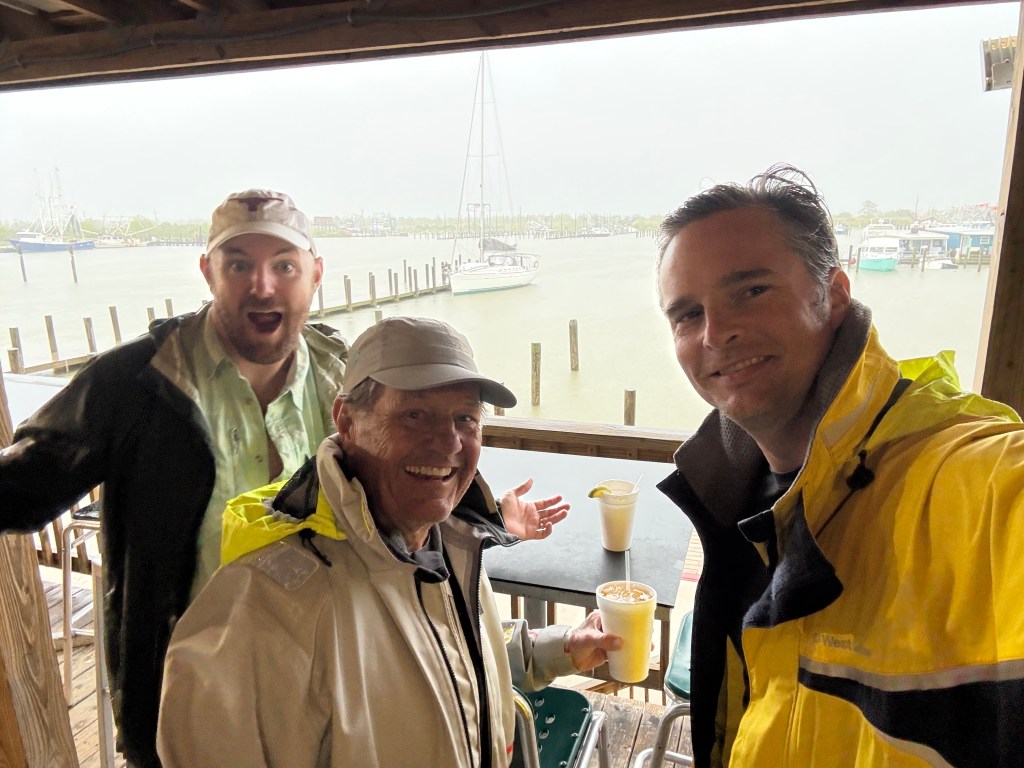
I will say we had a good dinner and some drinks alongside what appeared to be a large percentage of the 500 residents of Venice at the marina before heading to the boat to try and troubleshoot our engine/throttle issue and get some sleep.
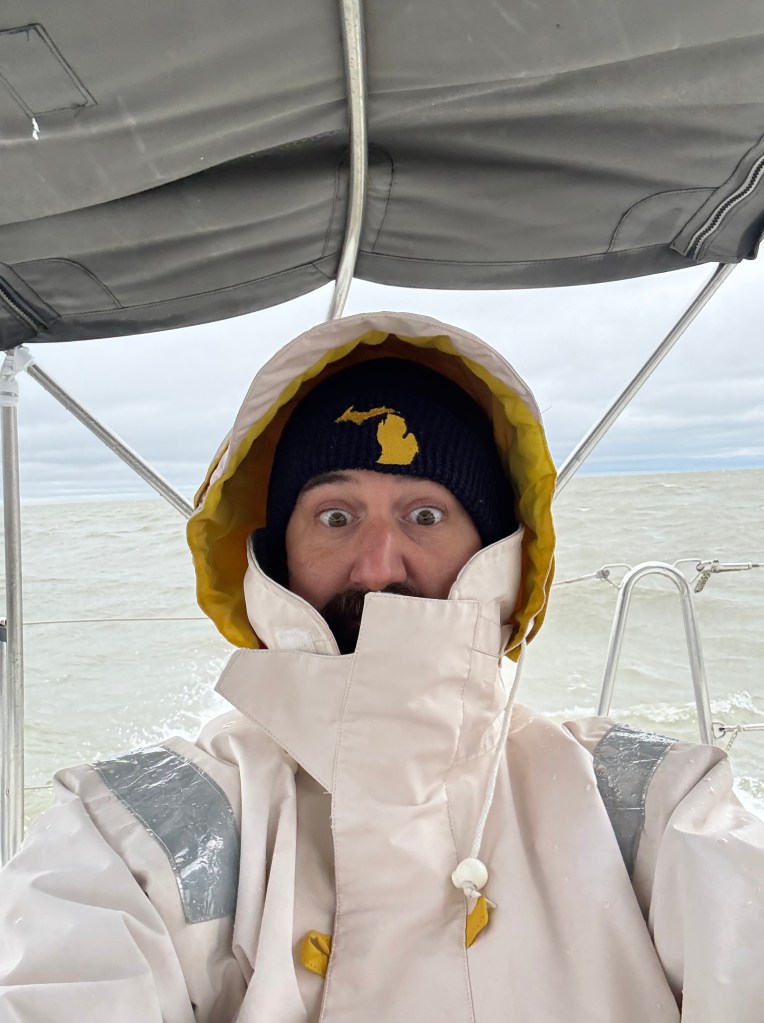
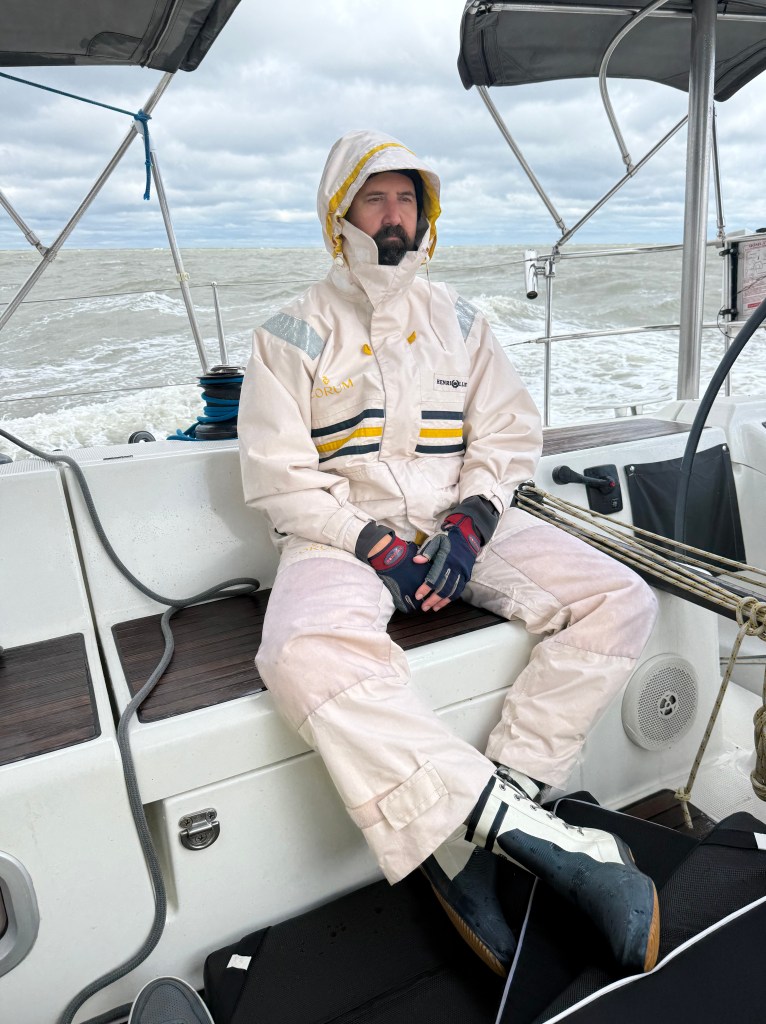
The throttle issue was not solved, but the sleep issue was definitely solved, even with waking up early and heading out in hopes of a better weather window. There was a lot of discussion about wind and potential giant swells, but we finally got out of the channel and got a sail up! We were sailing (motor sailing with just the jib, but still) and felt good, except for one detail. It’s cold. With the full force of the wind and weather system pushing it, we are all wearing full foul weather gear on top of every warm thing we brought. And it is bumping – we are heading on a tight reach into waves, bouncing all the way to Gulfport. Some sea sickness symptoms and not the best sleep, but we are making good time with the jib. We eventually need to turn up a bit, so we pull in the jib and watch the speed drop waaaay down. We decide to pull it back out and take the less direct angle at a faster speed, but soon start hearing a thumping. It sounds like someone below left a door open. I went down and found Will sitting up in the V berth wide-eyed, “I think it’s the bow.”
I run up on deck and see the new 85 lb Mantus (very pointy!) anchor has come loose and is slamming and swinging into the bow of the boat.
Dad keeps me from running up there directly. We pull in the jib, and I run up to the bow. It’s bad. There are big gashes in the fiberglass of the bow and scratches all the way up the starboard side. I find myself lying over the bow, trying to pull up the anchor, but can’t get it high enough. Christian and Daniel basically dog pile on top, and we eventually muscle it up and get it back in the bow roller after much shouting and struggling. I hold it down, and they bring me a line so I start lashing it down.
I realize it’s probably been loose since we used it to try and get off the ground the very first night. These are just the first real waves we’ve seen in three days. I finish lashing down the anchor a dozen different ways, and a dolphin pops up and looks right at me with what can only be described as a “what the hell are YOU doing” side eye. This is a strange trip.
I get back to the cockpit, and I’m defeated. I’m pissed. I’m shocked. I just can’t believe we can’t seem to go 24 hours without some kind of disaster.
We continue on. It’s cold, frustratingly cold, and on the last stretch into Gulfport, I take an extra shift to save Bill from having to come up into the pounding water, waves, and wind. I realize now I’m punishing myself for the anchor. We get to Gulfport, where Daniel and Will have to leave. We are already past the expected travel time for the trip, and they have work obligations. We give them huge thank yous and good luck, and they get into a rental car and drive all the way back to Houston for work. I can’t imagine that it was an easy drive.
Back on the boat at the fuel dock in Gulfport, we have a new problem. The bilge is full of water and not draining. Turns out the filters are full of mud, which is easy enough to clean, but still a bit of a mystery how we took on so much muddy water. I look at the remaining crew of Bill, Dad and Christian, and there is nothing else to do but continue on as the sun goes down.
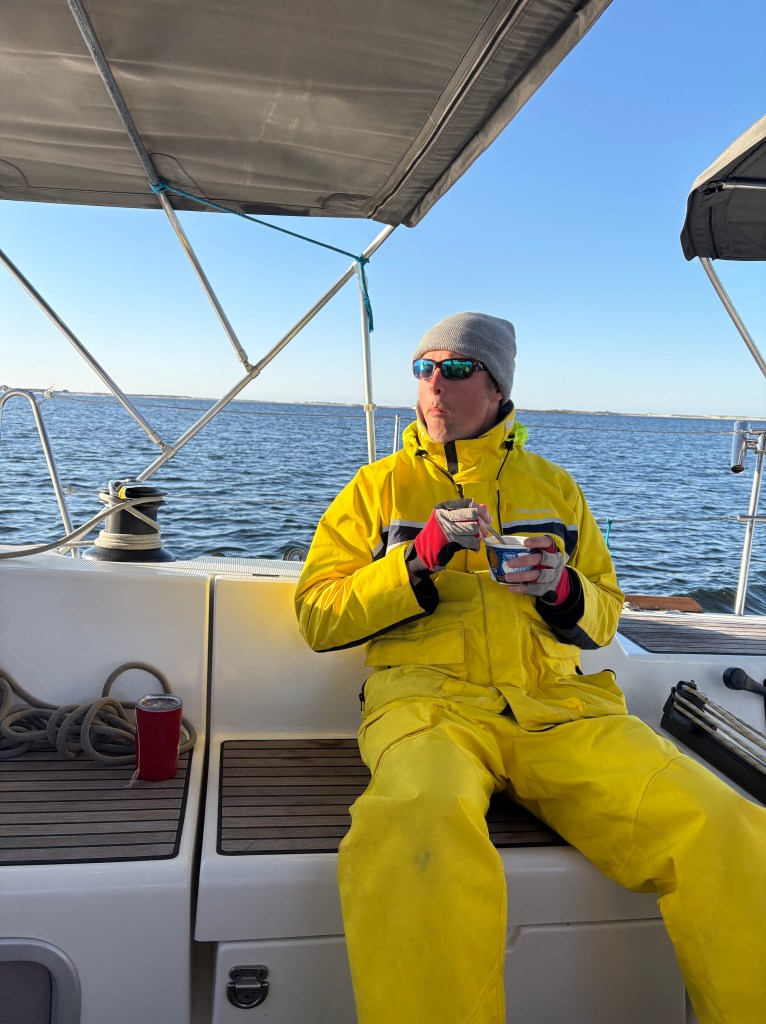
Getting out of Gulfport is a bit rough with unmarked channels and a big side swell, but once out of the bay, we are back in the calmer waters of the ICW and heading east to our final destination of Pensacola. Everyone is doing more driving with a shorter crew, but nothing we haven’t done over the past 4 days. It’s still cold, and we’re still tired, but we are getting closer and settling into shifts.
Because we shuffled shifts a bit, I got to see my first sunrise of the trip as we started coming into Pensacola, and at the end of the trip, it was beautiful. Bill and I watched the sun rise over white sand beaches with dolphins following for stretches. The wind has died down, so it isn’t as cold and starts warming as the sun comes up. Dad and Christian get a little breakfast going, and we all chat about the trip and life, but often nothing at all. We can now see the marina that is our final destination, with small figures of family waving us in.
We have one final engine hiccup (still investigating that mystery) as we come into the harbor, but I can see my family as we easily slide into the slip, and the harbormaster helps tie us off. I take the biggest breath of relief as I turn off the engine.
It’s done. We made it.
I rushed down and hugged the boys, Sue, and my Mom. And there are smiles and tears. Everyone is exhausted and excited and relieved and happy and just so damn glad to see each other.
There is champagne and snacks, and more hugs. I toast the crew and thank everyone who made it possible. We did it. And I was able to do it with my dad, which is something I’ll never forget, friends that I may never be able to repay, and with the support of my family and so many others who provided guidance and encouragement along the way. Thank you all – we did it!
Agora at Venice Marina, LAVenice Marina, LAthe crew at Venice Marina, LAthe crew at Venice Marina, LACaptain Barrett“the seas were angry that day”Farley on the approach to PensacolaBilly and Barrett, approaching Pensacola on the final morningChristian on the approach to Pensacolasunrise on the final day, approaching Pensacola
After the debacle of the night before, I say I’m driving. If this goes south, I want it to be me at the helm and responsible. It isn’t a complicated plan, but it’s still blowing 30 kts, and once we commit to going backward, there is no stopping. The crew will have to jump on board as we push off to make the turn. The walk goes relatively smoothly with Will, Christian and Daniel passing bumpers forward and rolling the boat along the land. But when they jump on and I go to reverse back into the docking area, the wind takes the bow faster than the stern.
We are now blowing quickly sideways toward a parked barge and the shore beyond. Lots of yelling. I reverse back to go into the channel, but now I’m tracking to slam backward into the other side of the docking area. I shift hard forward to avoid this, but now I’m drifting deep into the shore. I see Mr. Shell Morgan and his crew running to try to catch us. I go to neutral, the bow has to drift down so I can turn. So much yelling. I wait. More yelling. The bow drifts down, and I rev it into reverse and clear the far side parking lot by less than two feet. We have escaped Shell Morgan. Everyone is OK. Agora is OK. It could have gone so wrong, but we are on our way.
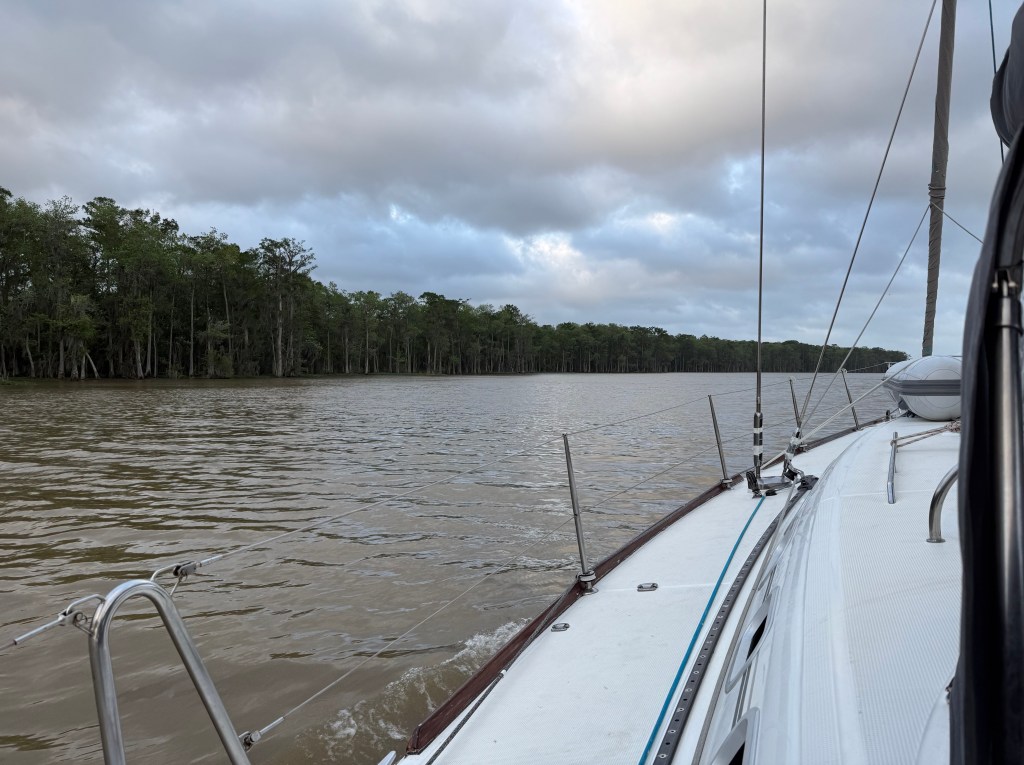
Everyone has gotten some sleep, and after our narrow escape, there is a fair amount of back-patting. Christian’s flying leap, Daniel turning on his SCUBA superpowers, and my narrow escape from the fumbled departure. We fall back into the hours of relative calm of motoring down the ICW in daylight. Spotting bald eagles and random swamp shacks.
In between, I’m planning the next bridges and fuel stops, the twists and turns. That’s about the time I realized our backup digital fuel gauge shows we are about empty. It’s been a long time since Shell Morgan, but not enough to be running empty. I could go into a lot of fuel burn math here that Bill walked me through, but the end result is the fuel gauge isn’t reading correctly, and due to my own short-sightedness, we didn’t actually fill up at Shell Morgan. We just filled up on what the fuel gauge was reading. So, we basically know nothing about the fuel level. But we’re pretty sure it would be extremely close to running out of fuel by Gulfport, and running out of diesel is a terrible option, especially since we would likely be in the middle of crossing the Mississippi River when it happened.
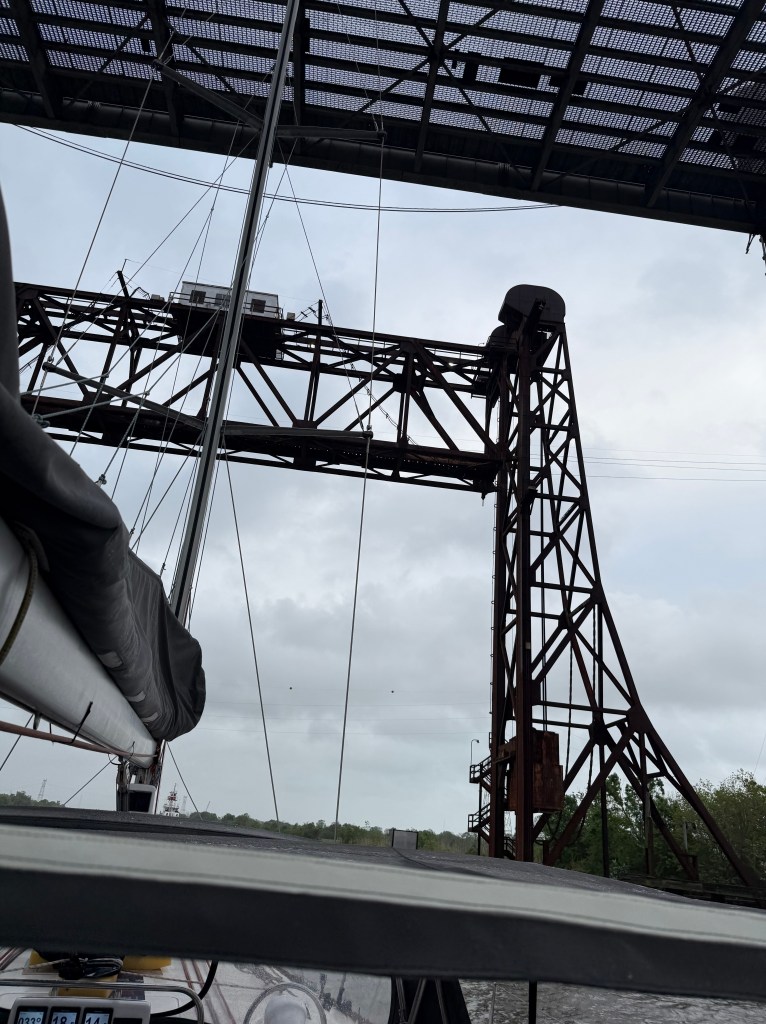
After much searching and talking with Oscar and a team of ICW experts who are now following the trip, we determined our only stop is at Morgan City. Only problem is that the fuel dock is just on the wrong side of a 50-foot bridge. Agora’s mast is 70’.
After some interesting calls with very helpful traffic control around Morgan City, we learn there is a public dock just on our side of the short bridge, and it is probably only a 10-minute walk to the fuel dock on the other side of the bridge. I sure am glad I bought four 5-gallon jerry cans instead of two 10-gallon ones. It took two trips and some sore shoulders, but we got Agora 100% filled up and even got some local BBQ to-go while we were there!
The adventure continues.
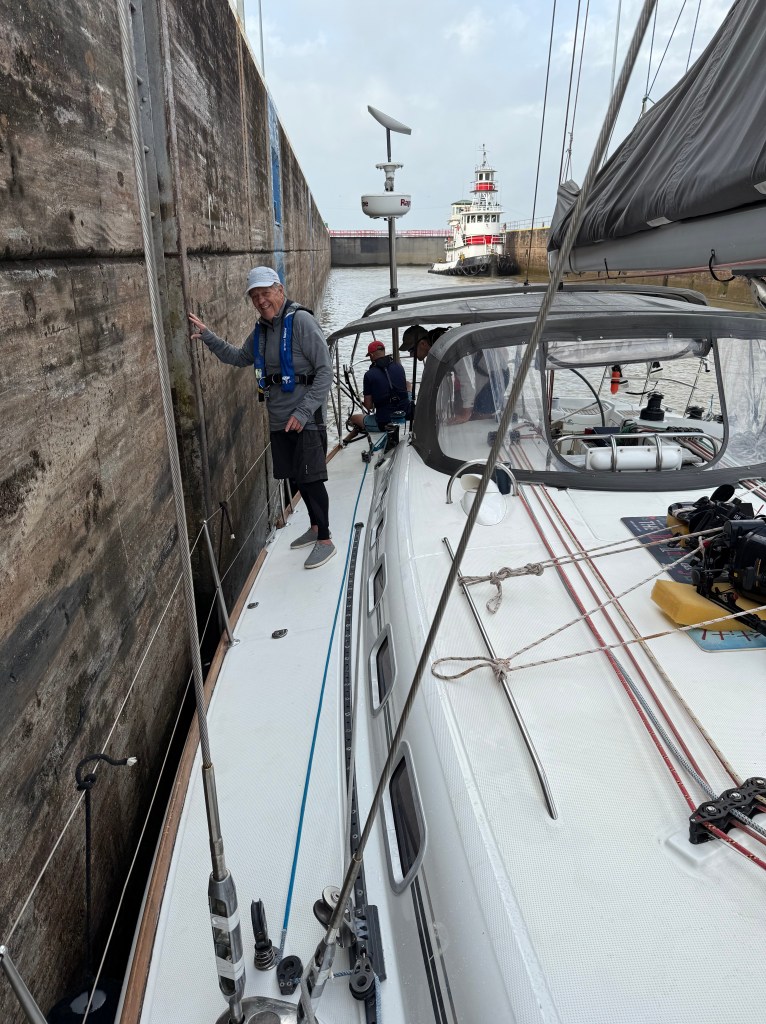
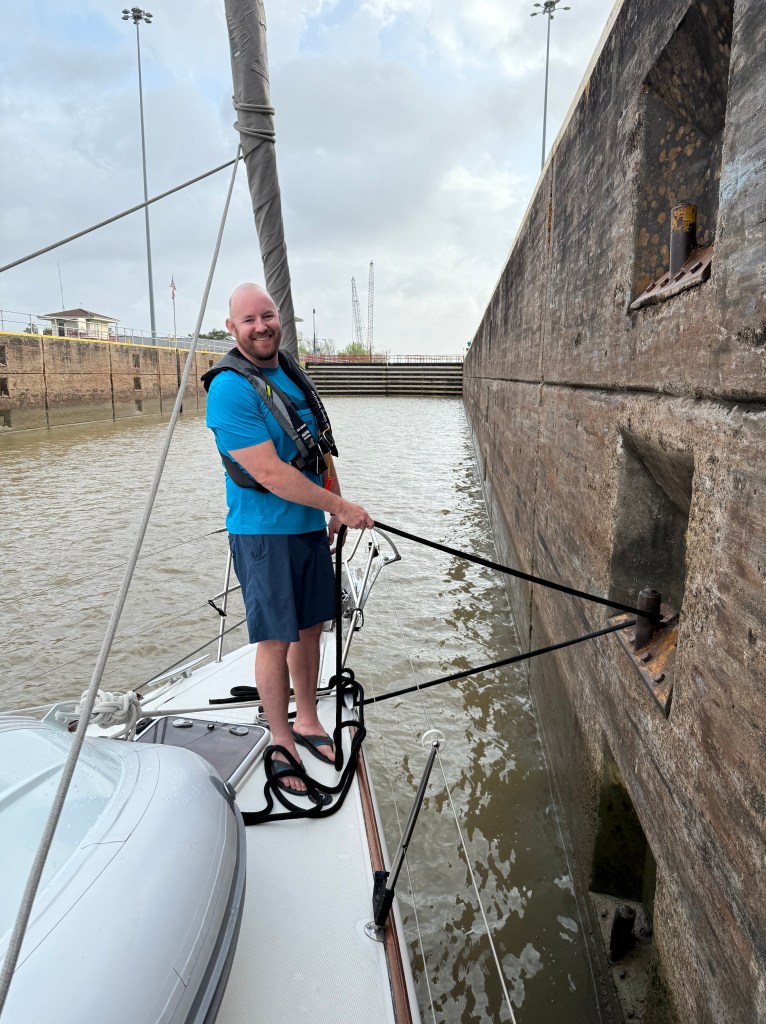
We’re over halfway there and feeling more comfortable with bridge and lock procedures, but there was a bigger lock just after Morgan City which wouldn’t be a big deal except as we go to stop in the middle, Bill (who is driving at the time) makes the “uh oh” sound, and says “I can’t get into reverse.” I look back to see black smoke coming out of the back and look over the side only to see what can be described as black sludge floating around the boat. I jump back and work the throttle, which suddenly engages and seems fine for now, but enough to give us a scare.
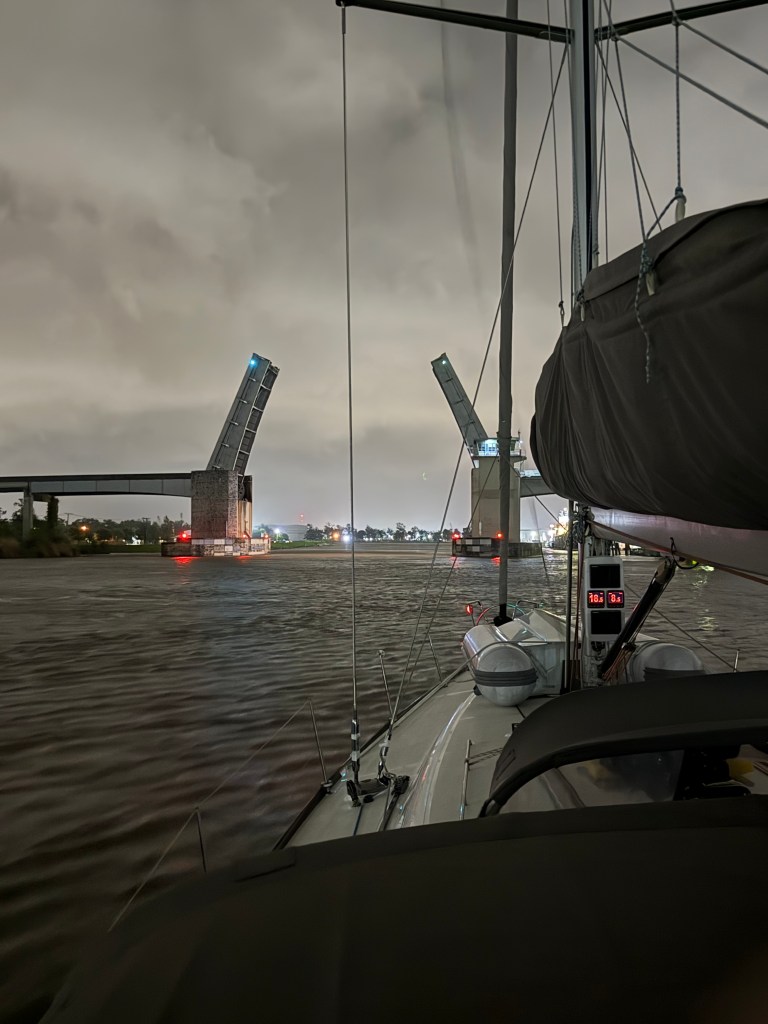
Things get back into a routine. Sleep, drive, watch, eat, sleep and continue. Scenery changes, swampland, industrial, neighborhoods, ports, shipyards, repeat. But, the procedure is about the same: radio any barges, bridges or locks you’re coming to, and be clear on your next steps and traffic. That is until we encounter a bridge operator we’re going to call “The Rose”.
I actually have a note from Oscar about this particular bridge operator, saying she is “a sweetie,” and we should be nice to her, but we caught her at a rough time. The wind is howling (it never actually stopped howling), and when I call her, she tells me the bridge can’t be raised in this much wind, so all traffic is stopped until the weather improves. Crap. We are now circling, burning fuel and time.
I come up for my shift to find Christian and my dad shining a spotlight on trees, random docks, and rusted-out barges, and arguing about what to tie up to. They have been circling for three hours and are both noticeably irritated.
Christian starts with, “We should just call the bridge again.” I tell him, “Go ahead, but they were clear they have to wait until the wind dies down.” Christian says, “I’m calling them.”
I would pay large sums to have a recording of this call, because after about 20 minutes, he comes up and tells us, “She’ll let us through, but don’t say it on the radio, so no one knows.” We laughed until he emphatically told us to go to the bridge as fast as we could. Maybe at some point I’ll get Christian to write a post about this, but my memory of the retelling went something like this.
Christian: “Hey, we are the sailboat that’s been circling around. And well, we’re getting low on fuel… any chance we can open the bridge soon?”
Rose of Larose: “We can’t in this wind, it can twist the bridge.”
Christian: “Oh, of course, and we wouldn’t want you to get in trouble or anything, but what if we came right up to the bridge, and <insert Christian swooshing sound here>, we speed under real quick so we don’t run out of gas.”
Rose of Larose: “Hell, get up here and don’t say anything on the radio, these barges have plenty of fuel.”
And sure enough, without horn or green light or public notice, the bridge was raised. And with Christian emphatically telling me to go faster, we scooted under and we’re back on our way again.
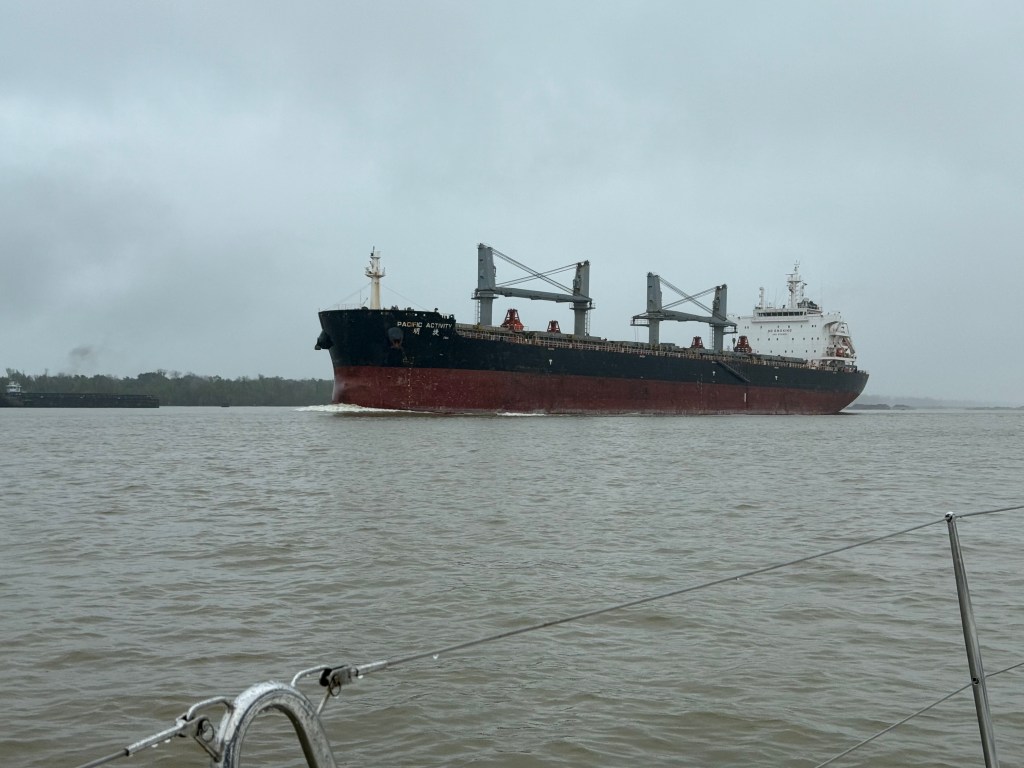
At this point, it’s Sunday morning. We’ve been going for about two and a half days of an estimated three and a half day journey, and we are gearing up for our final boss of logistics: the Mississippi River. I’ve been warned by multiple people – the Mississippi is wide, fast and full of large commercial tankers. You have locks and bridges on both sides of the river, so it’s an hour or two of nonstop radio comms and logistics while playing a big game of frogger with tankers.
But if we get past this final stretch, it’s basically a free pass to Gulfport, and an easy street to Pensacola. I flubbed the comms coming out of the first lock because at the moment I forgot the name of the lock we were leaving from, but a random barge jumped on and told them where we were leaving from and headed to (side note: these barge guys really are extremely nice and helpful).
We make our way across the Mississippi without issue, and the final lock gets us on its schedule behind a barge. I call ahead to the final lift bridge on this grand adventure – and our crash course in ICW navigation – to tell them we’re coming through. It’s been a bumpy road, but we’ve made it through groundings, crash landings, and fuel scares to the last bridge call of our three-day adventure. Just one more bridge.
ICW on the deliveryAgora and crew in a lockWill in a lockAgora passing under bridgesAgora prepared for a lift bridge on the ICWBilly on the ICW
As we got more comfortable and practiced with the hour-to-hour motoring down the ICW, we started realizing something interesting about Agora: she never used any fuel, not even a little bit. The fuel gauge was pinged at 100% after 24 hours of nonstop motoring at 2500 RPMs. I checked with Bill, and he agreed it probably isn’t right. Luckily, I had wired in a digital fuel gauge, so we had some reading. But, after working with Bill on calculating burn rates and estimates, it became clear that we don’t have a fuel gauge we can trust.
Something to note about the ICW is that it’s mostly industrial, so there are plenty of fuel stops for barges that will pump in diesel fast enough to rupture the tanks and flood a boat like Agora, but not a ton of stops good for fueling up a sailboat. For the record, we never saw another sailboat this entire trip on the ICW. Luckily, we were coming up to one of them in Shell Morgan, LA. Unfortunately, we were about 7 hours early. So, it’s the middle of the night, and they don’t open until 7 AM. And the wind has come up even more.
We’re tired; it’s dark, and we are some version of running out of fuel, and we come around the corner to this place and see essentially darkness. Maybe a building, could be a dock, perhaps a shrimp boat? I’ve been told there is a dock, but also a shallow spot to watch out for, and the wind is blowing us into the shore. So, no easy way to look for the right place to go.
Dad is driving, and I’m trying to guess if we can make it to the next fuel stop while Christian is trying to see through the darkness, and Daniel is on deck, about to start his shift. Bill & Will are both asleep. Dad says, “Let’s get closer. I think that’s the fuel dock.”
I want to be clear before we get to the next part: I’m the owner of this boat. This is my family’s home at this point. I am responsible for every decision, and it’s my job to keep the boat and the crew safe. At this point, I say nothing.
Dad points the nose down toward the dock, and we can see the fuel dock, but there is also a concrete parking lot 10 inches above the water before we get there, and very little room to maneuver. Dad says something to the effect of, “Get the bumpers, we can make it.”
My last chance to stop us, and I don’t. I feel we’ve committed. Should we have had all the crew on deck? Yes. Should we have discussed the approach? Yes. Should we have secured the dinghy first? Yes.
The next few minutes are very fast yet painfully long in memory, but they boil down to a few key moments:
“15 ft from parking lot, bad angle, reverse!” -me at midship as I point to the corner of cement we are being blown into
“Pull in the dinghy so we don’t run over it!” -Dad
Christian and Daniel scrambling to get the dinghy
Engine revs and abruptly stops
“Shit!” -Dad
Drifting toward the cement parking lot aimed about 10 ft back from the bow
“This is going to destroy the boat” -me
Christian makes a flying leap off the bow of the boat, probably an 8 ft drop onto uncertain ground, and I can’t believe he doesn’t break a leg. He saves the bow through some miracle of strength.
Daniel and I jump down and hold off midship, bumpers passed down and wedged between the boat and shore.
I scream every profanity I’ve ever learned.
It’s a bad situation but stable. The prop is fouled with the dinghy bow line, and the howling wind is blowing us against the shore, but the bumpers are holding, and Agora’s tied off. I don’t want to stay here, but there is nothing we can do until we get the bow line off the prop, so I start looking for sharp knives.
I’m holding a box cutter while Bill calmly explains that I’ll get in the water, swim under until I feel the shaft, and find a very tightly wrapped line and start cutting. It could take dozens of trips. I look down at the cold, dark, muddy water splashing in the 12-inch gap between Agora and shore as the boat shakes and bounces in the wind and waves. “I don’t think I can do it, guys.” There is a lot of talk of options or lack thereof until Daniel says, “I’ll go.” I’ll never forget this brief, but powerful interaction.
“Daniel, I can’t ask you to do something I’m not willing to do,” I say.
He puts his hand on my shoulder, “You have two kids. I’ll go.”
Daniel takes the box cutter and lowers himself into the water.
Daniel is an absolute legend. This isn’t easy. He is visibly nervous; it’s cold. It is a blind swim with a knife, and there are multiple times I’m holding my breath waiting for him to come back and about to jump in after him. It does take dozens of attempts, multiple knives are needed as some are dropped, but small bits of line are coming away. At some point, he just has to stop.
I decide to take a small gamble and try to reverse the engine, which does in fact work, and we are back in business – it’s a small victory. We can’t agree on an actual way to get off the shore, and everyone is exhausted. At this point, Agora has been stable and tied to shore for hours. We decide to wait until morning, get gas, and make a plan to get off the land, hopefully with less breeze. I’d like to say I woke up every hour to check the bumpers (Christian did) or that I researched ways to reverse off an obstruction. I lay down, sent a text to Sue explaining the situation, and fell instantly unconscious and slept.
The next morning, we meet Mr. Shell Morgan, the proprietor of the gas stop, who apparently has been running it for decades and lives up the hill. Quite the character from deep in Louisiana, but also someone who has barge experience and a few options about how we can definitely get clear without issue. We transfer jerry cans of fuel to Agora to fill her up (not as much as we thought – more adventures to come). The plan is for the crew to push Agora backward along the shore about 20 feet until we can swing the stern into a docking area so we can then motor forward into the channel and be on our way. Best laid plans…
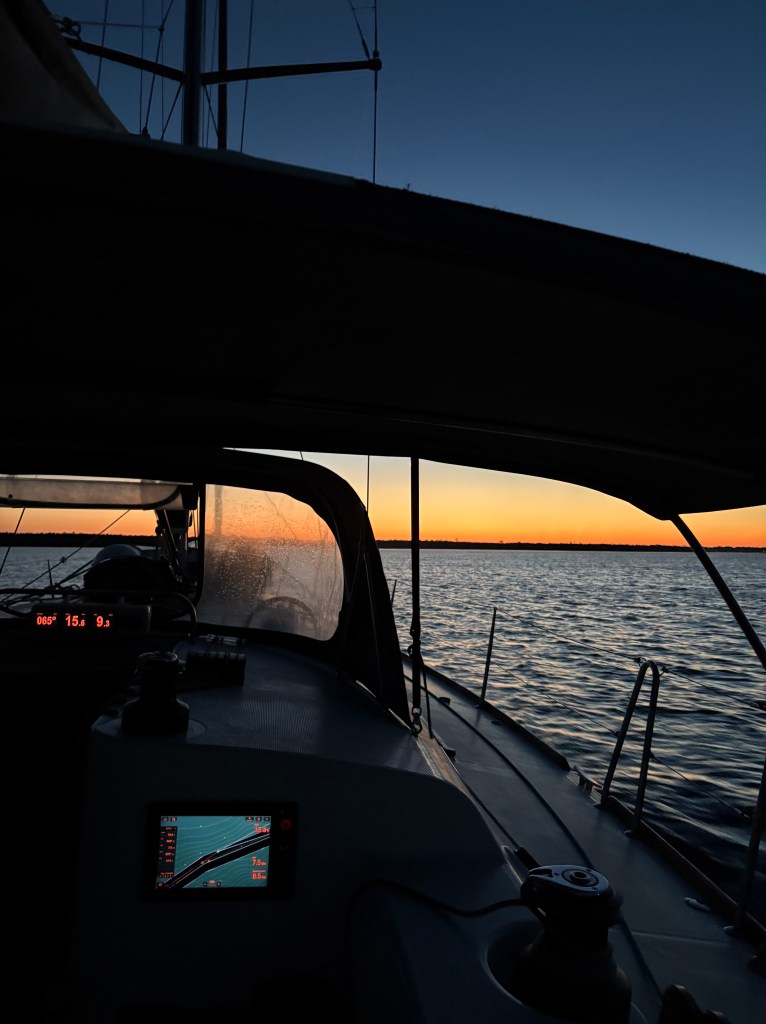
Agora in the ICWChristian in the ICWDaniel in the ICWthe ICW at nightAgora passing through the ICW
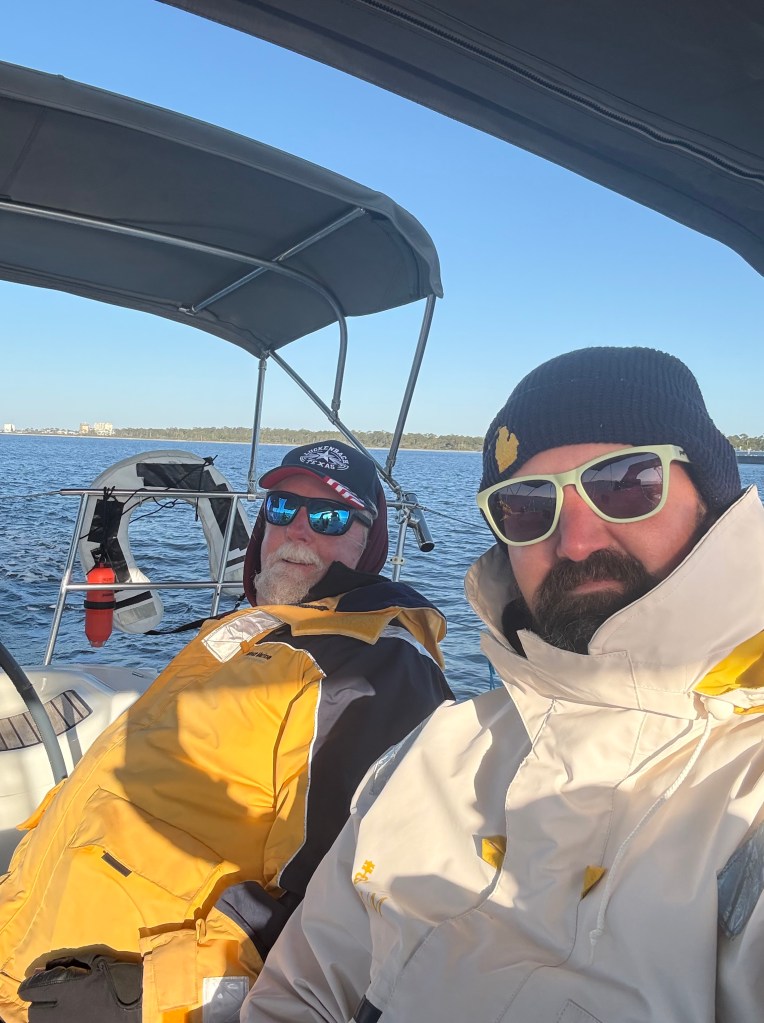
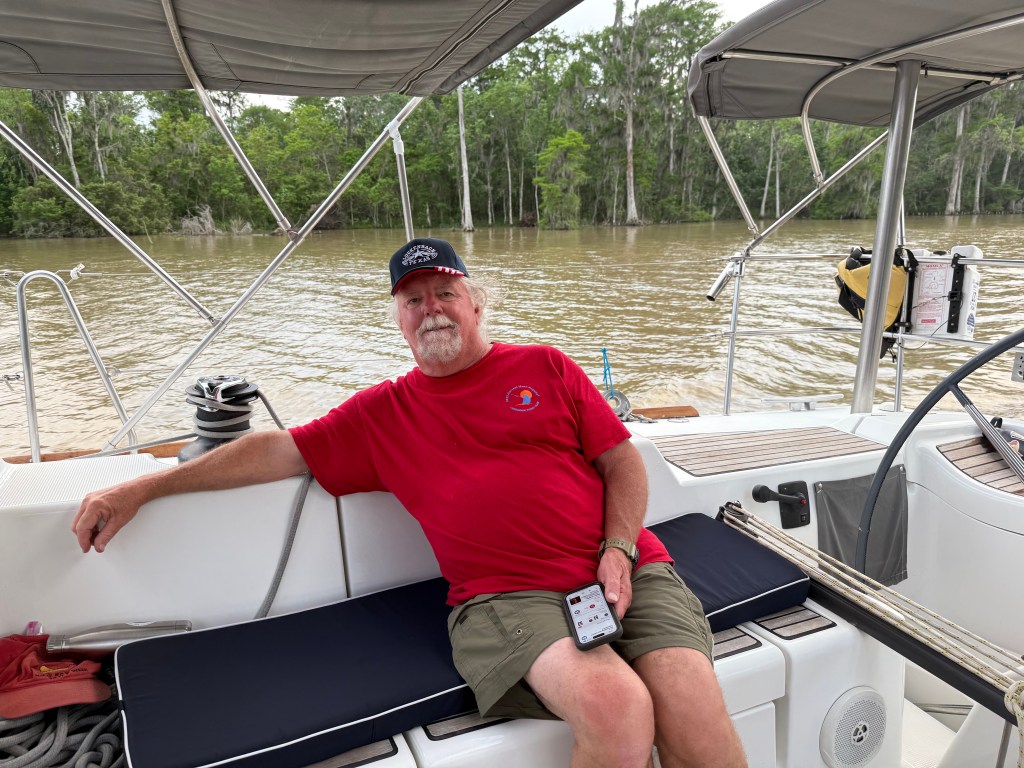
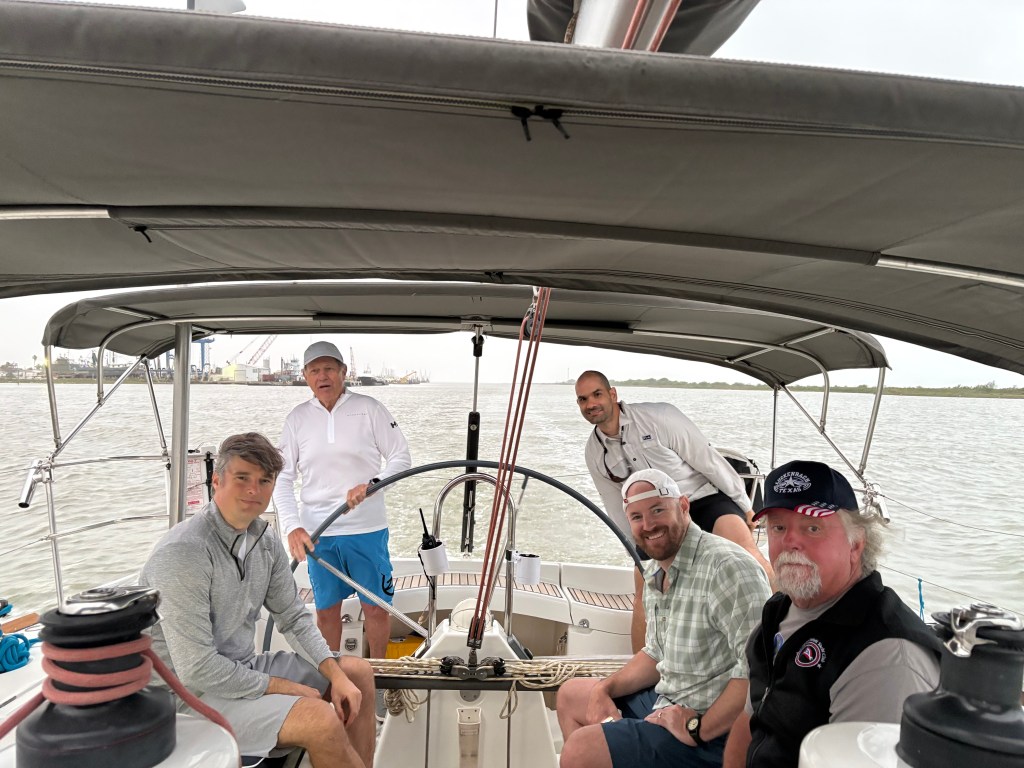
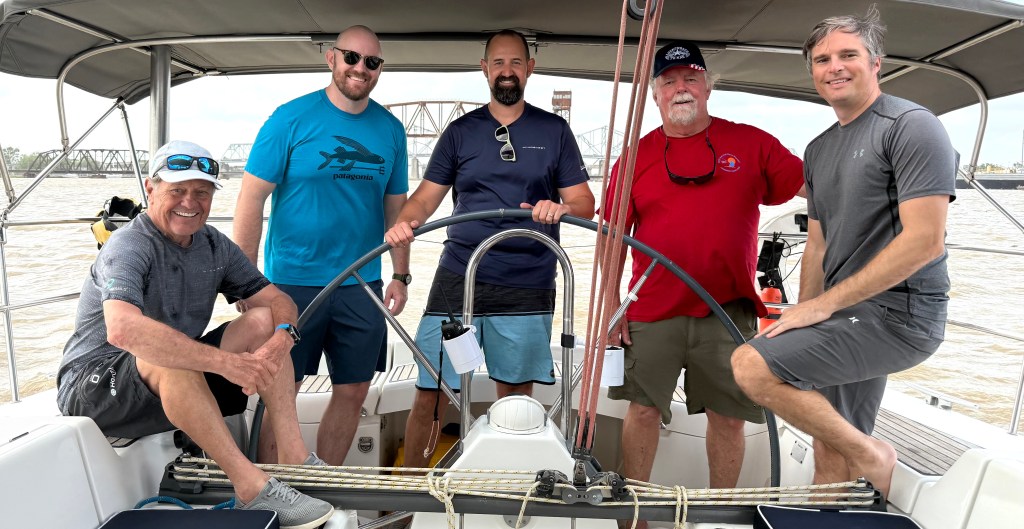
the crew, left to right: Christian, Farley, Daniel, Will, Bill
“It’s more than sporty out there,” Tom says as he shows me a buoy in the Gulf, registering sustained 30 kts with gusts to 50 kts. It’s an ominous start to a great adventure, but thank you, Tom, for sending me on a spiral to completely scrap and replan a passage from Kemah, TX, to Pensacola, FL, the day before departure.
I’m new to this kind of planning, but there is advice everywhere saying “don’t be on a schedule” or “sail based on the weather”. This is exactly what we plan to do moving forward, but for the first stretch across the Gulf, I lined up the A-Squad of seasoned sailors. All close friends and family… who all have real jobs and real schedules.
So when Tom puts the fear of 50 kts in me, I call out to the two most seasoned sailors on the crew: my dear old dad, Farley, and trusted sailor friend Bill, both have decades of ocean racing and passage planning experience. We all agree, “We have a problem. And if we want to keep this schedule, the ICW may be the only way.”
So, great. No problem. 24 hours to research and plan some of the most logistically complicated motoring you can do on a sailboat. We are talking drawbridges, barge traffic, water locks, and the absolute spiderweb of New Orleans canals/channels/rivers. For context, it took me about a week to come up with the outside route, which boiled down to “head east for 2 days and then turn north.”
In an unbelievable stroke of luck, a few weeks prior, I had an engine inspection done by Oscar Latiolais (if you’re in the Kemah area with a boat, write that name down), and we talked all about my family plans and his multiple monthly deliveries from Kemah to Gulfport. I had been trying to connect with him for a week about some travel plans and had given up hope. About 30 minutes into my 50 kts panic moment, I got a text. “I’m about 30 mins away if you’re around,” -Oscar.
I cannot explain what a pivotal moment this is in the story. Oscar shows up with all of the “you got this, no problem” bravado a cajun cousin can instill. After an hour spent bent over charts, I have a two page bulleted list of every bridge, procedure, phone number and stop needed to successfully traverse ~500 km of ICW between Galveston and Pensacola.
I cannot be more clear that we would have likely never left the dock, and certainly would have failed or struggled in the adventure we then decided to embark on, had it not been for Oscar and Tom.
For anyone reading this with a “wow, that was 5 paragraphs to decide to leave the dock” attitude – maybe just skip to the next blog post, this one may not be for you.
Alright. Everyone who’s still here, I promise, this was a real adventure, and I think you’ll be glad you stayed. Here’s a quick crew run down, as it informs a lot of the… adventure… and I think it’s best to get the bios clear up front.
Farley (aka Dad, to me)
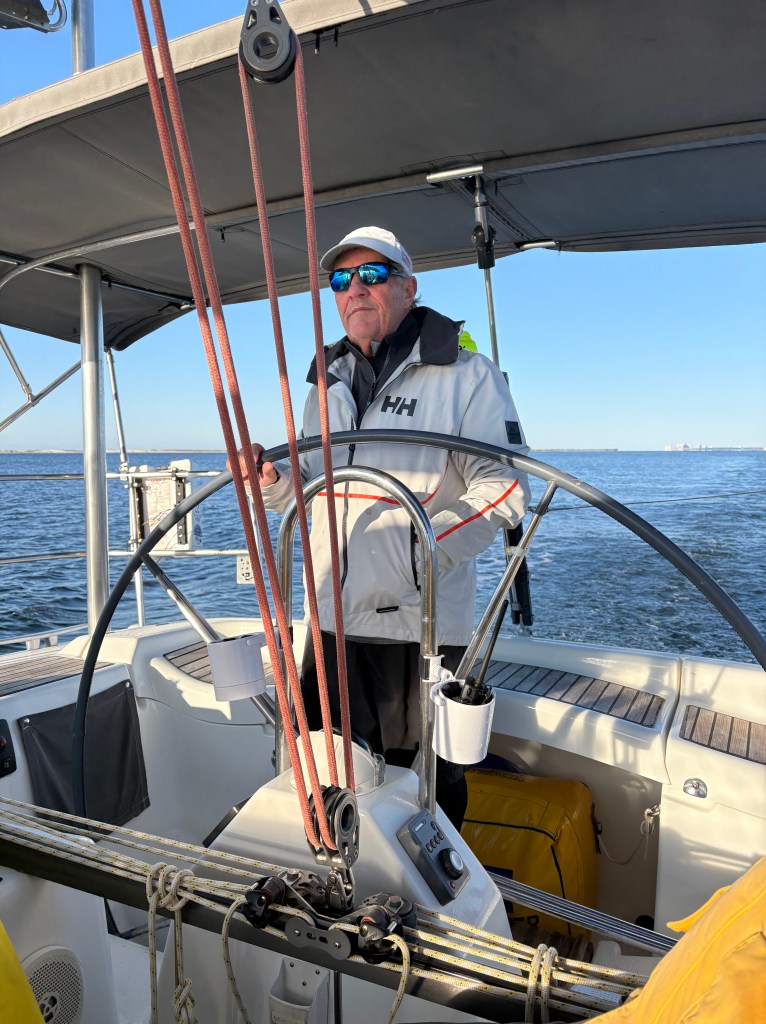
Professional sailor and sailmaker. Lifelong inspiration to me… how could I do this trip without him? Has an instinct toward fearless action and a story for any occasion.
Bill (aka Dad, to Will)
Seasoned sailor and passage maker with a passion for projects and introducing new people to sailing. Engineer and lifelong tinkerer, if it needs to get fixed, I’m calling Bill (yes, that was planned and, also, foreshadowing).
Will (general instigator)
Met in college sailing and have been on plenty of adventures together, both sailing and otherwise. The opposite of my risk-averse default. I can honestly say I wouldn’t have considered the liveaboard adventure without years of him telling me, “What’s the worst that could happen? It’ll be a good story either way.”
Christian (surfer dude with a competitive streak)
Another college sailing buddy I’ve been honored to sail with over the years. One of the truly nicest, most generous guys I’ve ever met, who will also yell at me while enraged on the race course.
Daniel (reliable wildcard)
A great friend who was wildly encouraging of the sailing adventure early on. The one non-sailor in the group and has a history of offshore rig diving and is a general contractor who can build anything. Key feature of I know he won’t freak out on the trip if things get rough.
Me (worthless boat owner with good friends)
Learning a lot and bringing people together to help me fulfill a dream of sailing around beautiful water with my family.
Day 1 went like most (I’m guessing): we started late, with everyone meeting up, and me scrambling to get people and the boat ready. Small detours like, “let’s just scrub the bottom of the dinghy real quick,” added hours to departure time. But at long last, we are off the dock in Kemah with Bill, Daniel, and me to meet up in Galveston with those who couldn’t get off work earlier. Don’t know if I would have chosen to leave Galveston at 7 PM, but when you’re gearing up for 3 days on the boat/traveling nonstop, it doesn’t really matter.
Big family hugs on the dock with Sue, my mom, the boys, and Aunt Mer Mer as we shove off and officially head to the ICW. Pretty surreal feeling actually leaving the dock, but also a lot of thinking: “What do I need to do next?” “Do I have all of the charts in?” “Do we have enough food?” (That one should never have been a worry, thanks Sue!) “I need to plan to radio Ellender Bridge 4 hrs ahead!” (This wasn’t a worry for 10 more hours, but was on my mind.) You know what I wasn’t thinking about? “Man, I hope we don’t run aground on the first day.”
After a little chatting and hanging on deck, we settled into watch rotation pretty quickly since it was already kind of late. My memory of our first unexpected adventure starts without a lot of preamble.
I was down looking at charts, Christian comes down after driving a while and starts asking about where we are and barely gets the sentence out before the boat spins hard to port, and I hear a string of expletives from my Dad up top (not the first or last time that happened). Christian and I run up to see him fighting to rev the engine and turn back into the channel, but it is quickly obvious that we are firmly and deeply aground in the mud. It was a joint effort of an overconfident senior sailor handing the wheel over to an overconfident new sailor in the middle of the night, but the result is the same: we’re stuck. Great start.
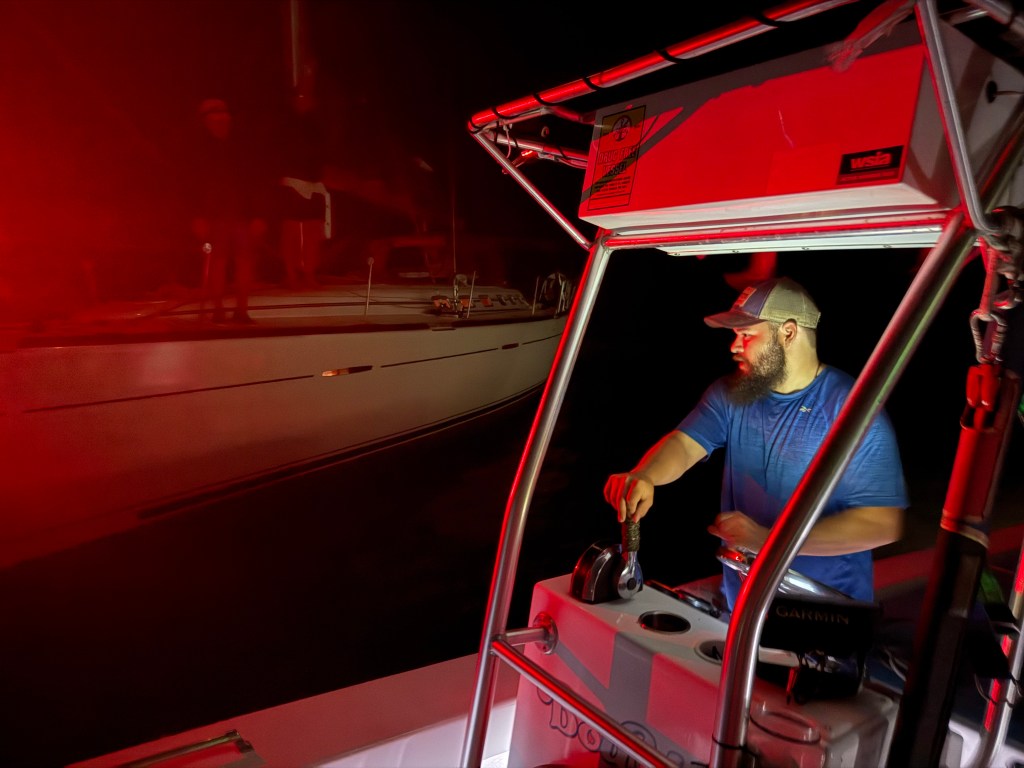
The next hour or so is a series of revving, rocking, and heeling the boat that gets us exactly nowhere. With Agora’s wing keel, none of these moves were ever going to work, so we deployed our secret weapon, the dinghy Squeasel! Turns out even the mighty power of the dinghy, combined with dropping and pulling on the anchor, is no match for the mighty mud. After circling Agora for a while with Christian, he looks over his shoulder and suggests we go ask for help at the restaurant. I honestly hadn’t noticed there was a restaurant a hundred yards away from the middle of the channel.
We pulled up to a bulkhead, tied up, and I realized quickly that they must serve a lot of oysters. I realize this by walking on oyster shells barefoot up to a back door that opens directly into the kitchen, as we pop our heads in with, “Hey, does anyone have a boat?”
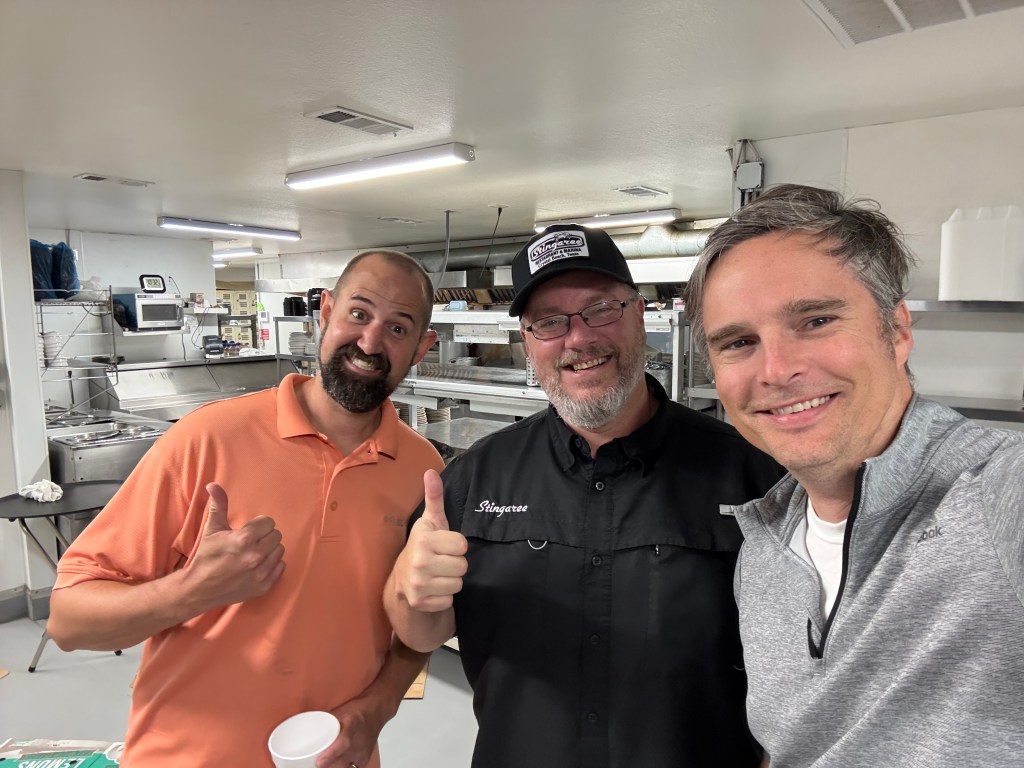
Reminder, it’s 10-11 PM, this place is closing down, and the kitchen staff, understandably a little surprised to see us, just shakes their head no. Here is why it’s important to have good friends with skills you don’t have. I am rightfully ashamed of our behavior and apologize, then start to turn around. Friendly, affable Christian, on the other hand, pushes in and asks if there is a manager around. Twenty minutes later, we are sipping water with the manager while we wait for his buddy with a parasailing business to launch his boat and proceed to drag Agora out of the mud at about 1 AM. I’d love to say it was good to get the drama out early in the trip. I cannot say that.
Once back on our way, we were getting our first real experience of the ICW. One of the truly sobering moments of the trip was me coming up for my first real night shift. I pass Will coming down, who is fairly wide-eyed and gives me a, “it’s pretty wild,” as I go up. I get on deck, and Dad is just saying, loudly and with emphasis, “This is hard!”
A footnote here would explain that I’ve seen Will calmly recount near-death experiences and brushes with the law. And I’ve seen my father skippering trimarans with broken rudders going 20 kts in the middle of the night in blinding rain, but I’ve never heard him call anything involving sailing “hard”. I look around, and with the cloud cover there are no stars, no moon. It is pitch black.
If you look very closely, you realize you can see grass 30 feet to starboard as we hug that coast, so when barges come the other direction every hour or so, you have 15 feet between you and the giant industrial machine that wouldn’t notice if it hit you. It IS hard. We were all getting a crash course in driving by chart and over communicating to every barge on AIS about how we were going to carefully pass them. And don’t forget, it’s still blowing 30 kts.
I could go into detail about every lift and swing bridge we have to radio to open, but I’ll give you a break. I have a very detailed text string back to Oscar confirming our next moves and asking questions. It was still the first day when he texted, “Now you have a LIFT, a LOCK, a SWING, and a GROUNDING under your belt. That’s known as a Seasoned Professional Skipper.”
If only any of us knew how much more we had to learn.
Farley, Will, Barrett, Billy, Christian (photo by Daniel)Agora ran aground and needed some help getting pulled off.Barrett, Stingaree Manager, Christian
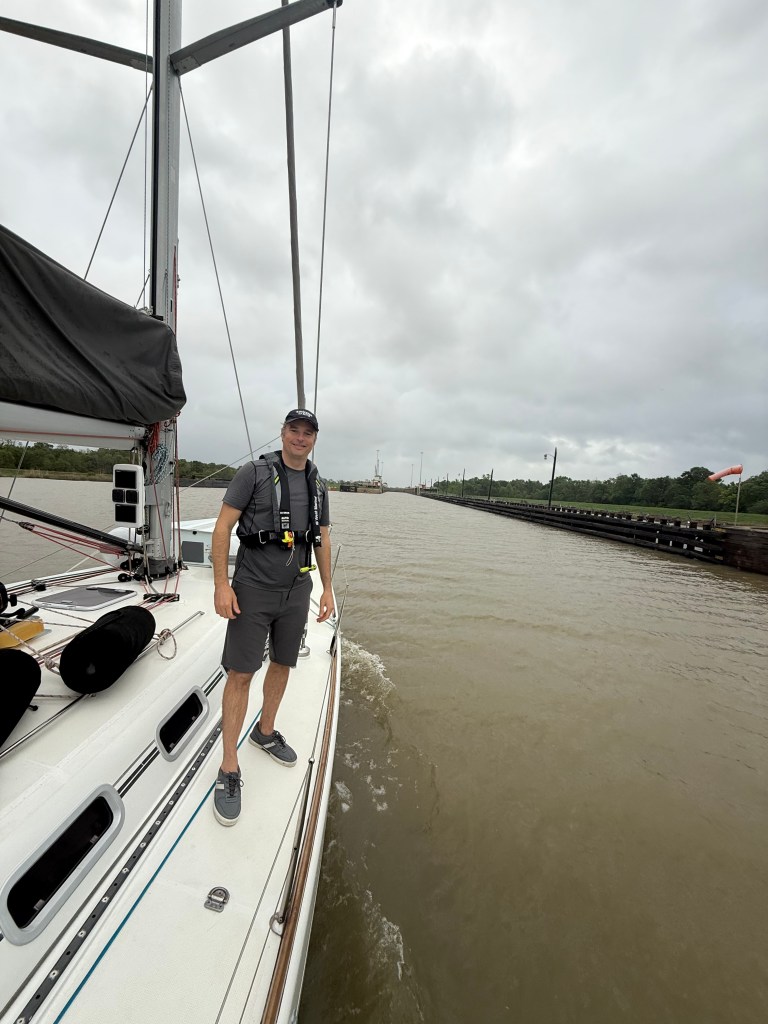
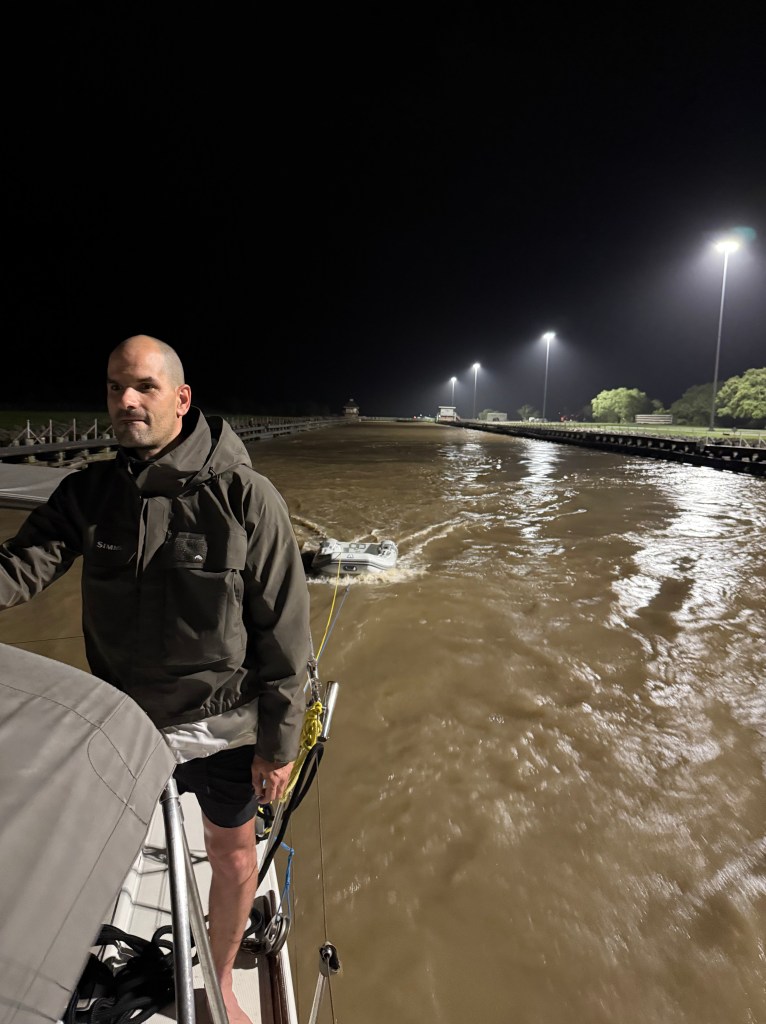
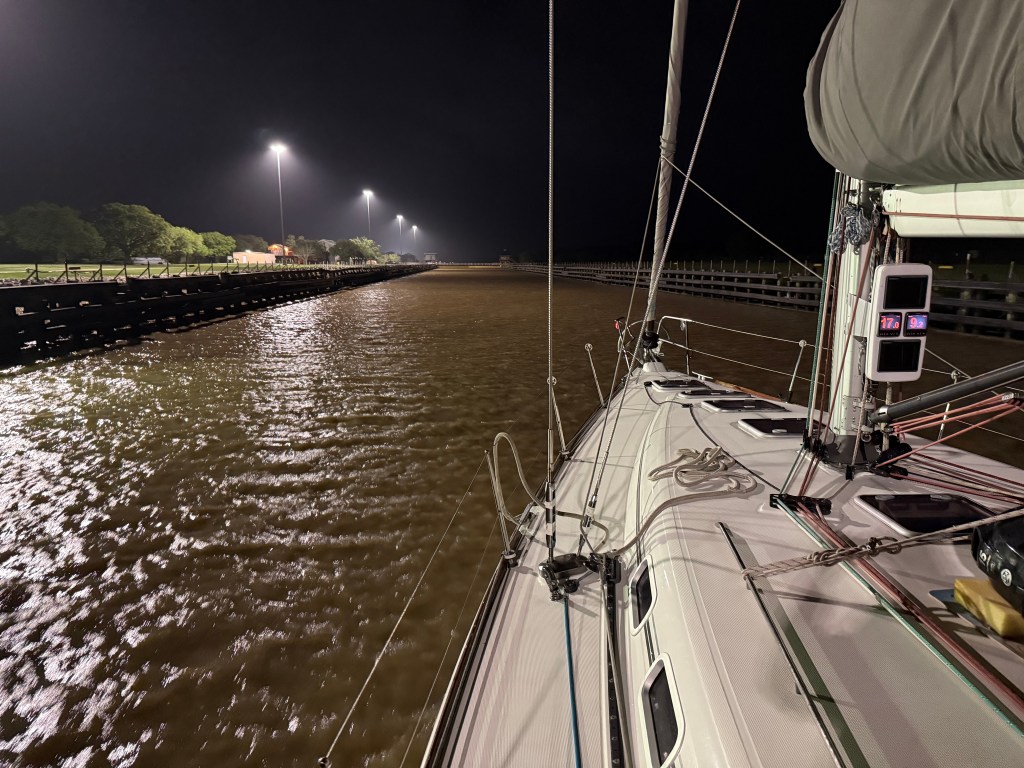
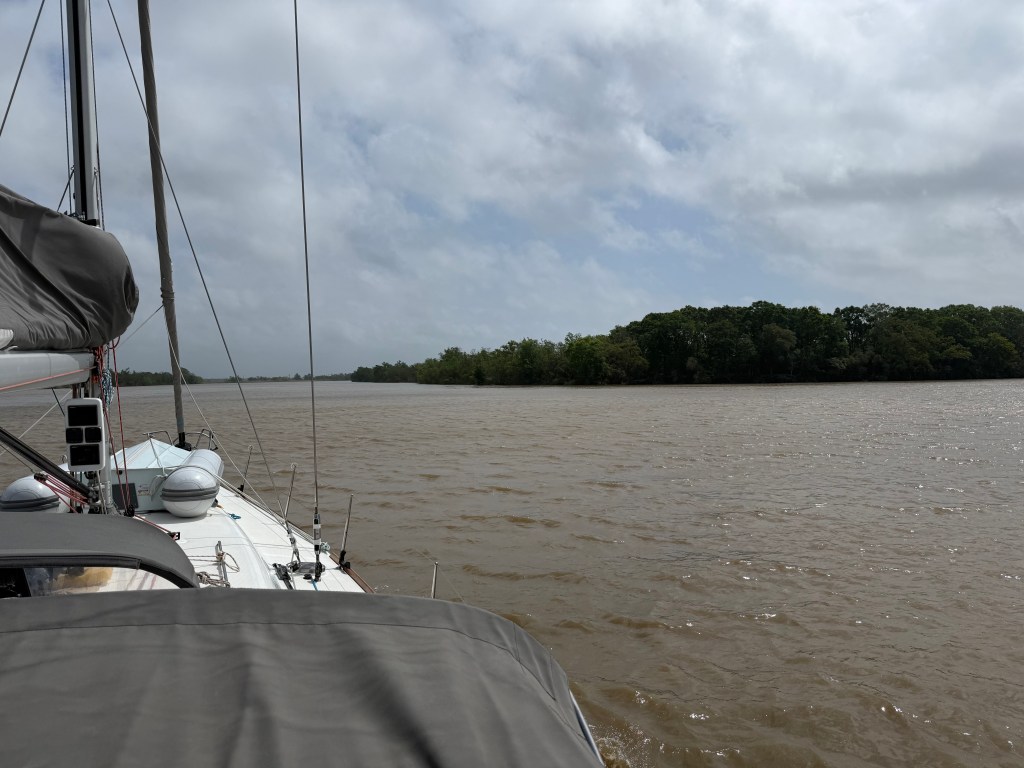
 Sailing Agora