“It’s more than sporty out there,” Tom says as he shows me a buoy in the Gulf, registering sustained 30 kts with gusts to 50 kts. It’s an ominous start to a great adventure, but thank you, Tom, for sending me on a spiral to completely scrap and replan a passage from Kemah, TX, to Pensacola, FL, the day before departure.
I’m new to this kind of planning, but there is advice everywhere saying “don’t be on a schedule” or “sail based on the weather”. This is exactly what we plan to do moving forward, but for the first stretch across the Gulf, I lined up the A-Squad of seasoned sailors. All close friends and family… who all have real jobs and real schedules.
So when Tom puts the fear of 50 kts in me, I call out to the two most seasoned sailors on the crew: my dear old dad, Farley, and trusted sailor friend Bill, both have decades of ocean racing and passage planning experience. We all agree, “We have a problem. And if we want to keep this schedule, the ICW may be the only way.”
So, great. No problem. 24 hours to research and plan some of the most logistically complicated motoring you can do on a sailboat. We are talking drawbridges, barge traffic, water locks, and the absolute spiderweb of New Orleans canals/channels/rivers. For context, it took me about a week to come up with the outside route, which boiled down to “head east for 2 days and then turn north.”
In an unbelievable stroke of luck, a few weeks prior, I had an engine inspection done by Oscar Latiolais (if you’re in the Kemah area with a boat, write that name down), and we talked all about my family plans and his multiple monthly deliveries from Kemah to Gulfport. I had been trying to connect with him for a week about some travel plans and had given up hope. About 30 minutes into my 50 kts panic moment, I got a text. “I’m about 30 mins away if you’re around,” -Oscar.
I cannot explain what a pivotal moment this is in the story. Oscar shows up with all of the “you got this, no problem” bravado a cajun cousin can instill. After an hour spent bent over charts, I have a two page bulleted list of every bridge, procedure, phone number and stop needed to successfully traverse ~500 km of ICW between Galveston and Pensacola.
I cannot be more clear that we would have likely never left the dock, and certainly would have failed or struggled in the adventure we then decided to embark on, had it not been for Oscar and Tom.
For anyone reading this with a “wow, that was 5 paragraphs to decide to leave the dock” attitude – maybe just skip to the next blog post, this one may not be for you.
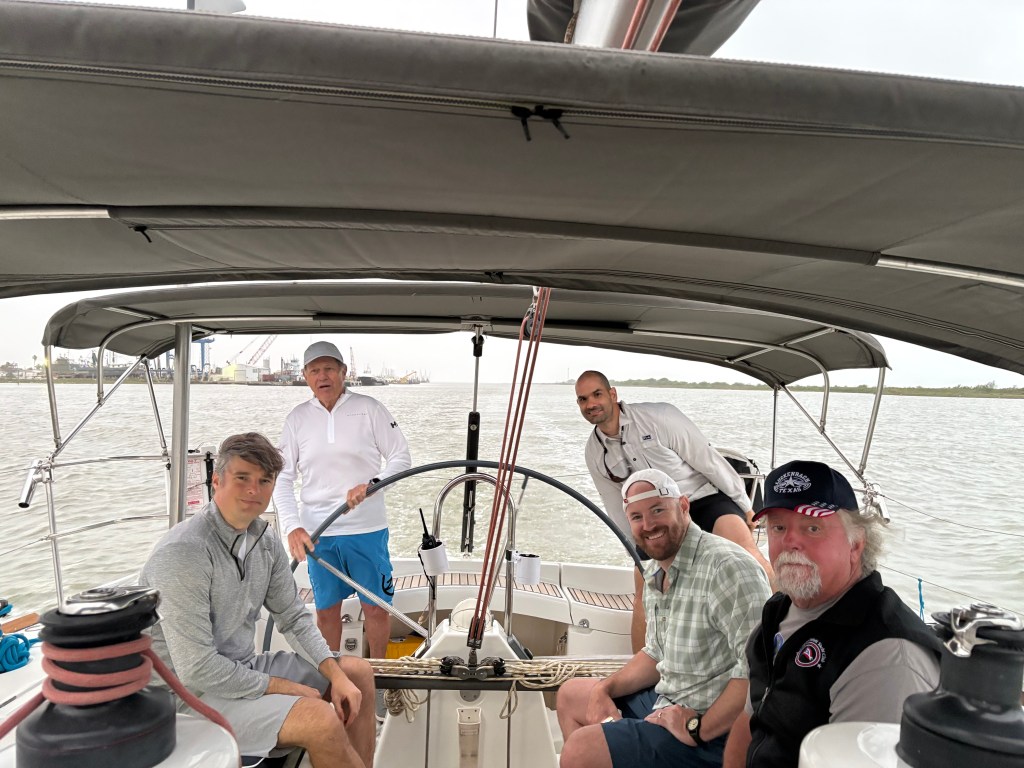
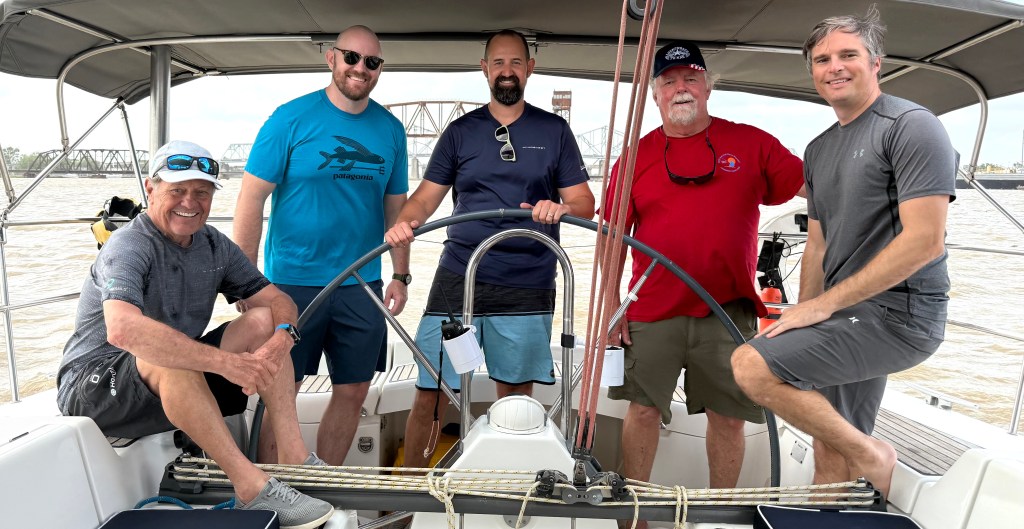
Alright. Everyone who’s still here, I promise, this was a real adventure, and I think you’ll be glad you stayed. Here’s a quick crew run down, as it informs a lot of the… adventure… and I think it’s best to get the bios clear up front.
- Farley (aka Dad, to me)
- Professional sailor and sailmaker. Lifelong inspiration to me… how could I do this trip without him? Has an instinct toward fearless action and a story for any occasion.
- Bill (aka Dad, to Will)
- Seasoned sailor and passage maker with a passion for projects and introducing new people to sailing. Engineer and lifelong tinkerer, if it needs to get fixed, I’m calling Bill (yes, that was planned and, also, foreshadowing).
- Will (general instigator)
- Met in college sailing and have been on plenty of adventures together, both sailing and otherwise. The opposite of my risk-averse default. I can honestly say I wouldn’t have considered the liveaboard adventure without years of him telling me, “What’s the worst that could happen? It’ll be a good story either way.”
- Christian (surfer dude with a competitive streak)
- Another college sailing buddy I’ve been honored to sail with over the years. One of the truly nicest, most generous guys I’ve ever met, who will also yell at me while enraged on the race course.
- Daniel (reliable wildcard)
- A great friend who was wildly encouraging of the sailing adventure early on. The one non-sailor in the group and has a history of offshore rig diving and is a general contractor who can build anything. Key feature of I know he won’t freak out on the trip if things get rough.
- Me (worthless boat owner with good friends)
- Learning a lot and bringing people together to help me fulfill a dream of sailing around beautiful water with my family.
Day 1 went like most (I’m guessing): we started late, with everyone meeting up, and me scrambling to get people and the boat ready. Small detours like, “let’s just scrub the bottom of the dinghy real quick,” added hours to departure time. But at long last, we are off the dock in Kemah with Bill, Daniel, and me to meet up in Galveston with those who couldn’t get off work earlier. Don’t know if I would have chosen to leave Galveston at 7 PM, but when you’re gearing up for 3 days on the boat/traveling nonstop, it doesn’t really matter.
Big family hugs on the dock with Sue, my mom, the boys, and Aunt Mer Mer as we shove off and officially head to the ICW. Pretty surreal feeling actually leaving the dock, but also a lot of thinking: “What do I need to do next?” “Do I have all of the charts in?” “Do we have enough food?” (That one should never have been a worry, thanks Sue!) “I need to plan to radio Ellender Bridge 4 hrs ahead!” (This wasn’t a worry for 10 more hours, but was on my mind.) You know what I wasn’t thinking about? “Man, I hope we don’t run aground on the first day.”
After a little chatting and hanging on deck, we settled into watch rotation pretty quickly since it was already kind of late. My memory of our first unexpected adventure starts without a lot of preamble.
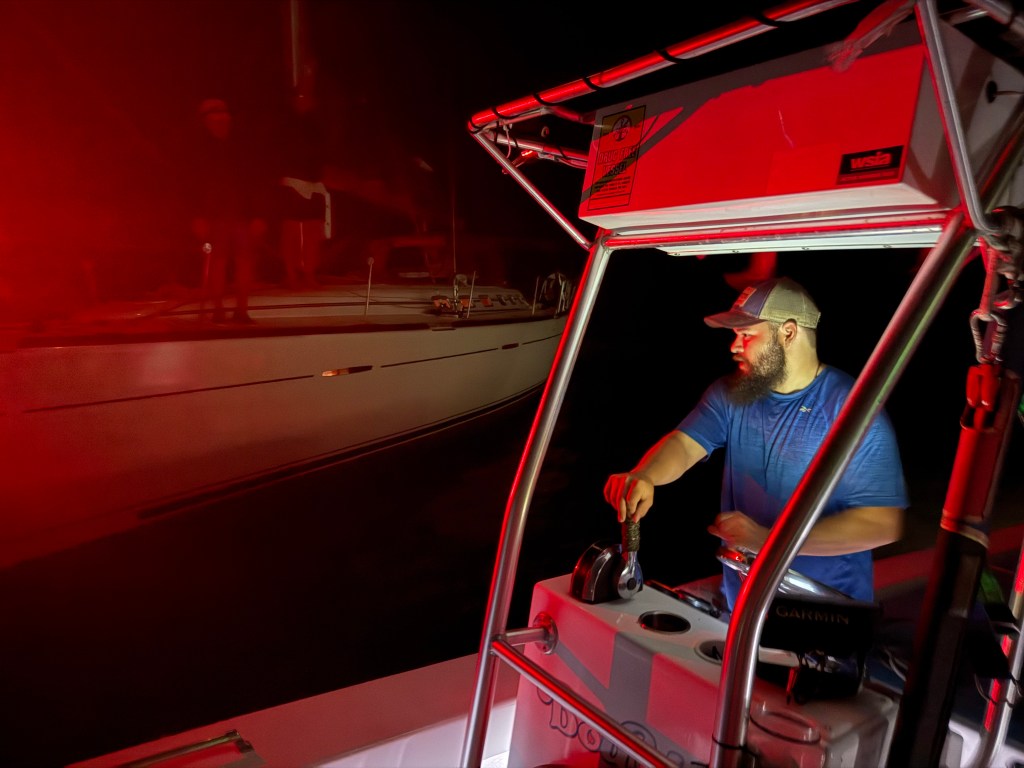
I was down looking at charts, Christian comes down after driving a while and starts asking about where we are and barely gets the sentence out before the boat spins hard to port, and I hear a string of expletives from my Dad up top (not the first or last time that happened). Christian and I run up to see him fighting to rev the engine and turn back into the channel, but it is quickly obvious that we are firmly and deeply aground in the mud. It was a joint effort of an overconfident senior sailor handing the wheel over to an overconfident new sailor in the middle of the night, but the result is the same: we’re stuck. Great start.
The next hour or so is a series of revving, rocking, and heeling the boat that gets us exactly nowhere. With Agora’s wing keel, none of these moves were ever going to work, so we deployed our secret weapon, the dinghy Squeasel! Turns out even the mighty power of the dinghy, combined with dropping and pulling on the anchor, is no match for the mighty mud. After circling Agora for a while with Christian, he looks over his shoulder and suggests we go ask for help at the restaurant. I honestly hadn’t noticed there was a restaurant a hundred yards away from the middle of the channel.
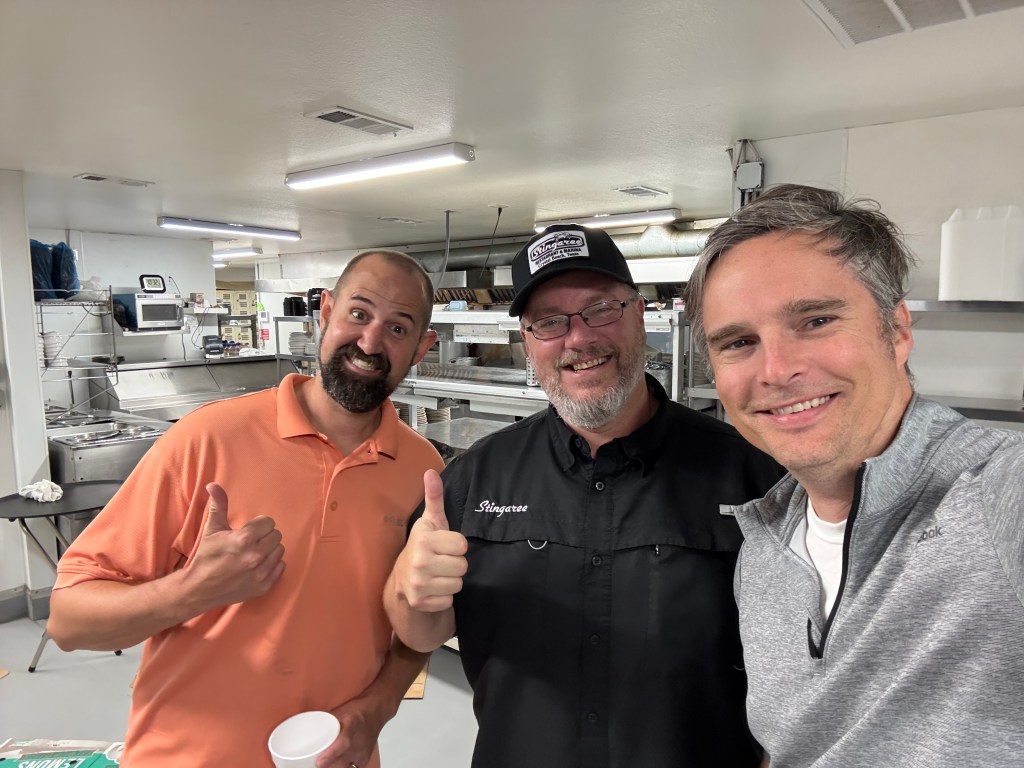
We pulled up to a bulkhead, tied up, and I realized quickly that they must serve a lot of oysters. I realize this by walking on oyster shells barefoot up to a back door that opens directly into the kitchen, as we pop our heads in with, “Hey, does anyone have a boat?”
Reminder, it’s 10-11 PM, this place is closing down, and the kitchen staff, understandably a little surprised to see us, just shakes their head no. Here is why it’s important to have good friends with skills you don’t have. I am rightfully ashamed of our behavior and apologize, then start to turn around. Friendly, affable Christian, on the other hand, pushes in and asks if there is a manager around. Twenty minutes later, we are sipping water with the manager while we wait for his buddy with a parasailing business to launch his boat and proceed to drag Agora out of the mud at about 1 AM. I’d love to say it was good to get the drama out early in the trip. I cannot say that.
Once back on our way, we were getting our first real experience of the ICW. One of the truly sobering moments of the trip was me coming up for my first real night shift. I pass Will coming down, who is fairly wide-eyed and gives me a, “it’s pretty wild,” as I go up. I get on deck, and Dad is just saying, loudly and with emphasis, “This is hard!”
A footnote here would explain that I’ve seen Will calmly recount near-death experiences and brushes with the law. And I’ve seen my father skippering trimarans with broken rudders going 20 kts in the middle of the night in blinding rain, but I’ve never heard him call anything involving sailing “hard”. I look around, and with the cloud cover there are no stars, no moon. It is pitch black.
If you look very closely, you realize you can see grass 30 feet to starboard as we hug that coast, so when barges come the other direction every hour or so, you have 15 feet between you and the giant industrial machine that wouldn’t notice if it hit you. It IS hard. We were all getting a crash course in driving by chart and over communicating to every barge on AIS about how we were going to carefully pass them. And don’t forget, it’s still blowing 30 kts.
I could go into detail about every lift and swing bridge we have to radio to open, but I’ll give you a break. I have a very detailed text string back to Oscar confirming our next moves and asking questions. It was still the first day when he texted, “Now you have a LIFT, a LOCK, a SWING, and a GROUNDING under your belt. That’s known as a Seasoned Professional Skipper.”
If only any of us knew how much more we had to learn.
 Sailing Agora
Leave a comment