As we got more comfortable and practiced with the hour-to-hour motoring down the ICW, we started realizing something interesting about Agora: she never used any fuel, not even a little bit. The fuel gauge was pinged at 100% after 24 hours of nonstop motoring at 2500 RPMs. I checked with Bill, and he agreed it probably isn’t right. Luckily, I had wired in a digital fuel gauge, so we had some reading. But, after working with Bill on calculating burn rates and estimates, it became clear that we don’t have a fuel gauge we can trust.
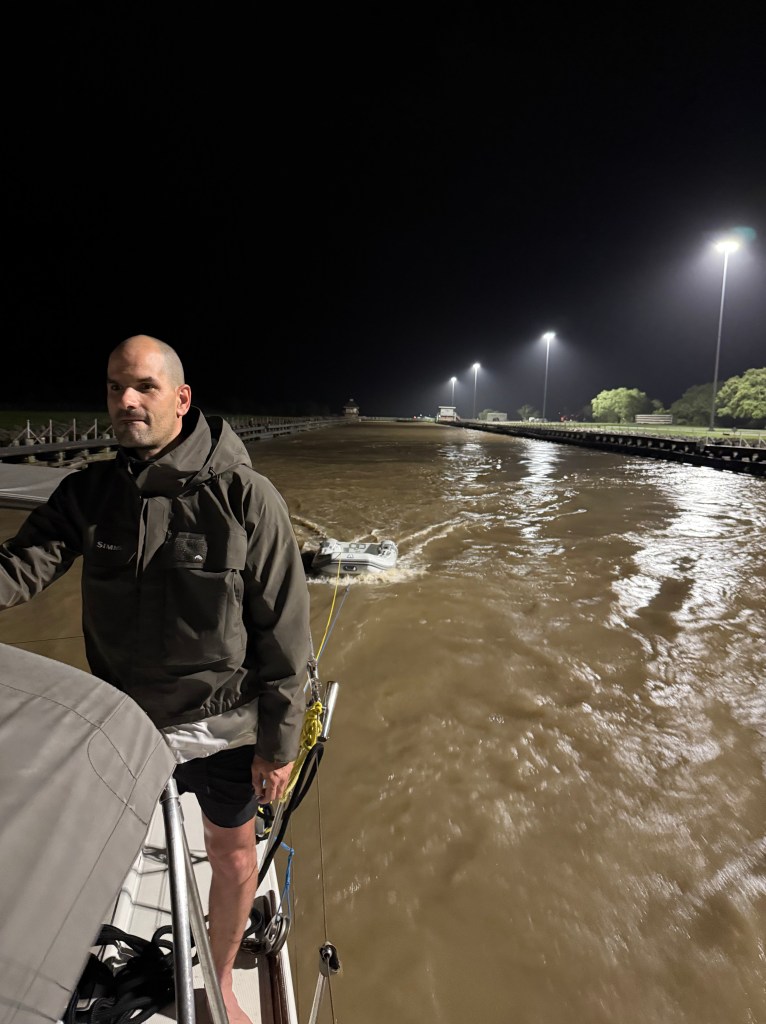
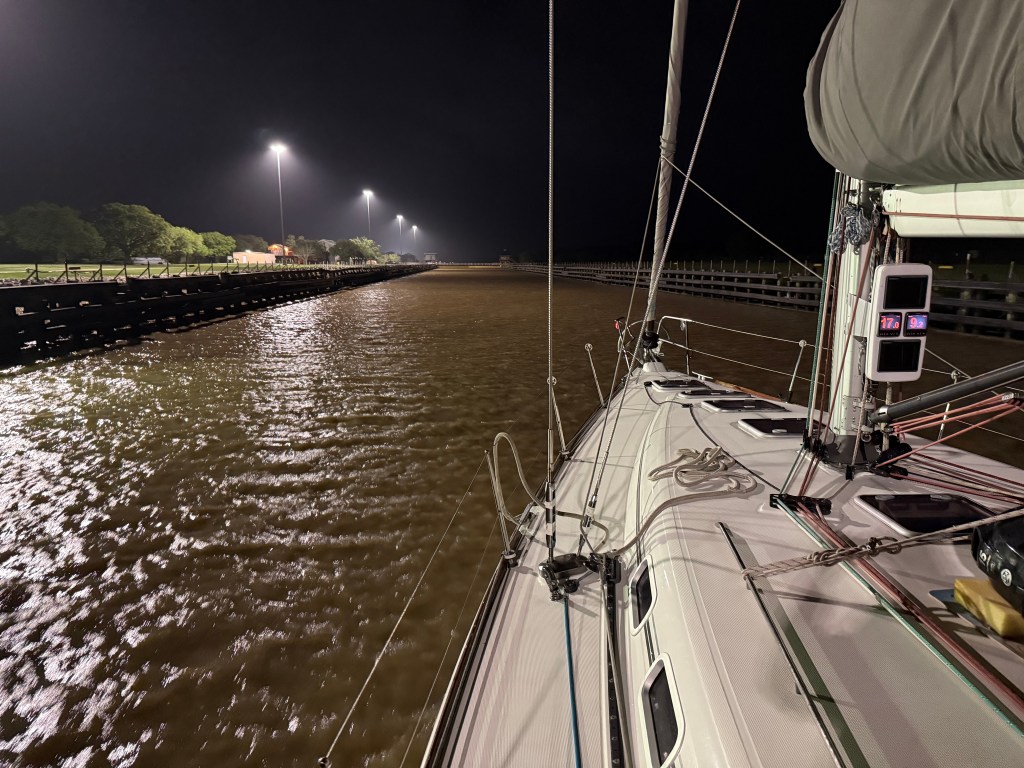
Something to note about the ICW is that it’s mostly industrial, so there are plenty of fuel stops for barges that will pump in diesel fast enough to rupture the tanks and flood a boat like Agora, but not a ton of stops good for fueling up a sailboat. For the record, we never saw another sailboat this entire trip on the ICW. Luckily, we were coming up to one of them in Shell Morgan, LA. Unfortunately, we were about 7 hours early. So, it’s the middle of the night, and they don’t open until 7 AM. And the wind has come up even more.
We’re tired; it’s dark, and we are some version of running out of fuel, and we come around the corner to this place and see essentially darkness. Maybe a building, could be a dock, perhaps a shrimp boat? I’ve been told there is a dock, but also a shallow spot to watch out for, and the wind is blowing us into the shore. So, no easy way to look for the right place to go.
Dad is driving, and I’m trying to guess if we can make it to the next fuel stop while Christian is trying to see through the darkness, and Daniel is on deck, about to start his shift. Bill & Will are both asleep. Dad says, “Let’s get closer. I think that’s the fuel dock.”
I want to be clear before we get to the next part: I’m the owner of this boat. This is my family’s home at this point. I am responsible for every decision, and it’s my job to keep the boat and the crew safe. At this point, I say nothing.
Dad points the nose down toward the dock, and we can see the fuel dock, but there is also a concrete parking lot 10 inches above the water before we get there, and very little room to maneuver. Dad says something to the effect of, “Get the bumpers, we can make it.”
My last chance to stop us, and I don’t. I feel we’ve committed. Should we have had all the crew on deck? Yes. Should we have discussed the approach? Yes. Should we have secured the dinghy first? Yes.
The next few minutes are very fast yet painfully long in memory, but they boil down to a few key moments:
- “15 ft from parking lot, bad angle, reverse!” -me at midship as I point to the corner of cement we are being blown into
- “Pull in the dinghy so we don’t run over it!” -Dad
- Christian and Daniel scrambling to get the dinghy
- Engine revs and abruptly stops
- “Shit!” -Dad
- Drifting toward the cement parking lot aimed about 10 ft back from the bow
- “This is going to destroy the boat” -me
- Christian makes a flying leap off the bow of the boat, probably an 8 ft drop onto uncertain ground, and I can’t believe he doesn’t break a leg. He saves the bow through some miracle of strength.
- Daniel and I jump down and hold off midship, bumpers passed down and wedged between the boat and shore.
- I scream every profanity I’ve ever learned.
It’s a bad situation but stable. The prop is fouled with the dinghy bow line, and the howling wind is blowing us against the shore, but the bumpers are holding, and Agora’s tied off. I don’t want to stay here, but there is nothing we can do until we get the bow line off the prop, so I start looking for sharp knives.
I’m holding a box cutter while Bill calmly explains that I’ll get in the water, swim under until I feel the shaft, and find a very tightly wrapped line and start cutting. It could take dozens of trips. I look down at the cold, dark, muddy water splashing in the 12-inch gap between Agora and shore as the boat shakes and bounces in the wind and waves. “I don’t think I can do it, guys.” There is a lot of talk of options or lack thereof until Daniel says, “I’ll go.” I’ll never forget this brief, but powerful interaction.
- “Daniel, I can’t ask you to do something I’m not willing to do,” I say.
- He puts his hand on my shoulder, “You have two kids. I’ll go.”
- Daniel takes the box cutter and lowers himself into the water.
Daniel is an absolute legend. This isn’t easy. He is visibly nervous; it’s cold. It is a blind swim with a knife, and there are multiple times I’m holding my breath waiting for him to come back and about to jump in after him. It does take dozens of attempts, multiple knives are needed as some are dropped, but small bits of line are coming away. At some point, he just has to stop.
I decide to take a small gamble and try to reverse the engine, which does in fact work, and we are back in business – it’s a small victory. We can’t agree on an actual way to get off the shore, and everyone is exhausted. At this point, Agora has been stable and tied to shore for hours. We decide to wait until morning, get gas, and make a plan to get off the land, hopefully with less breeze. I’d like to say I woke up every hour to check the bumpers (Christian did) or that I researched ways to reverse off an obstruction. I lay down, sent a text to Sue explaining the situation, and fell instantly unconscious and slept.
The next morning, we meet Mr. Shell Morgan, the proprietor of the gas stop, who apparently has been running it for decades and lives up the hill. Quite the character from deep in Louisiana, but also someone who has barge experience and a few options about how we can definitely get clear without issue. We transfer jerry cans of fuel to Agora to fill her up (not as much as we thought – more adventures to come). The plan is for the crew to push Agora backward along the shore about 20 feet until we can swing the stern into a docking area so we can then motor forward into the channel and be on our way. Best laid plans…
 Sailing Agora
Leave a comment